Automated Incident Response
Detection tells you an attacker is present. Containment determines whether they stay. Automated Incident Response layer, the response orchestration engine within the SIEM & XDR platform is engineered to execute machine-speed containment. Empower your security operations center with deeply integrated, identity-aware playbooks that proactively neutralize advanced adversaries and dramatically reduce your mean time to respond.
The Second Clock: Why Detection Alone Is Not a Security Outcome
The enterprise security community has made substantial progress on detection. Modern SIEM and XDR platforms correlate telemetry at scale, machine learning models surface behavioral anomalies with increasing accuracy, and mean time to detect has steadily declined across mature security organizations. But reducing MTTD is only half of the problem.
When a confirmed incident lands in a SOC analyst's queue, a second clock starts running and this clock is governed not by detection algorithms but by human coordination. The analyst must triage the alert across multiple consoles, determine the blast radius of the incident, decide which containment actions are appropriate, manually execute those actions one system at a time, notify the correct stakeholders through separate channels, and document every step often while simultaneously managing a queue of other high-priority alerts. In highly manual SOC environments, this sequence takes hours. Hours during which an attacker is still present, lateral movement is still possible, and exfiltration is still underway.
The response paralysis problem is structural. It is a byproduct of security architectures that treat detection and response as separate disciplines, executed by separate tools, connected by human hands. SOAR platforms have historically required extensive custom integration work and continuous maintenance overhead. And even well-configured playbooks fail when the identity layer is absent: containing an incident without the authority to immediately revoke the compromised credentials driving it is containment theater.
Automated Incident Response layer is the execution engine embedded within the SIEM & XDR platform. It is engineered to operate downstream of detection: converting high-confidence incidents into coordinated, cross-platform response sequences that execute at machine speed, enforce scoped and reversible containment, invoke identity response actions natively via IDHub, and maintain the governance audit trail that regulators and boards require from every incident that crosses a materiality threshold.
Not a Dashboard. An Execution Engine.
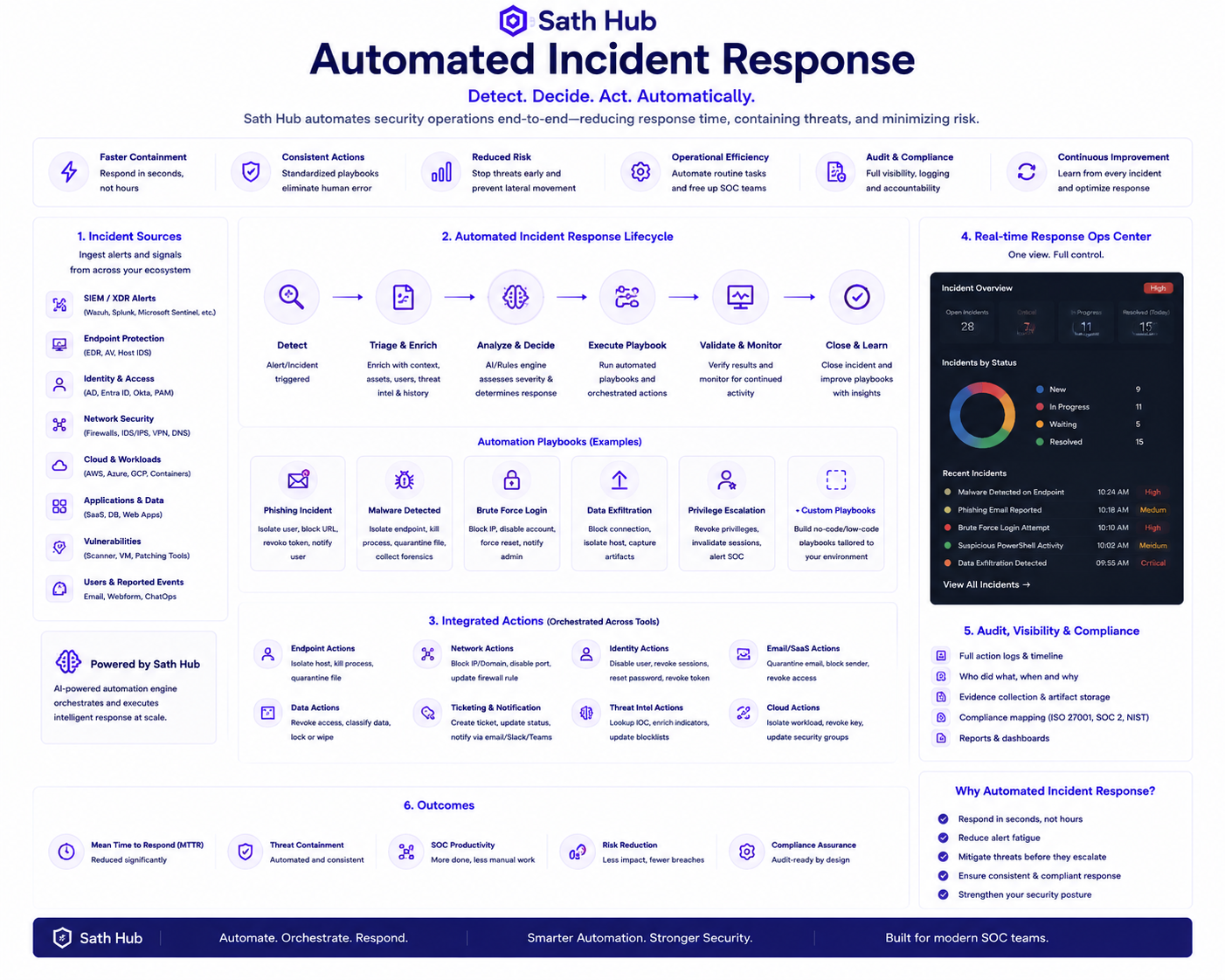
Automated Incident Response is the response orchestration layer—the component that receives high-confidence incidents from the platform's detection engine and executes the downstream response lifecycle: playbook selection, containment action dispatch, cross-tool coordination, identity response actuation via IDHub, case evidence assembly, analyst escalation routing, and post-incident closure documentation.
The distinction between a detection platform and a response execution engine matters for a precise reason: they fail at different points and require different design philosophies. A detection engine must be maximally sensitive to signal, it errors on the side of surfacing events for human review. A response engine must be maximally precise about action, it must execute with confidence, minimum blast radius, and complete reversibility where required. Designing both into the same undifferentiated system is how organizations end up with automated responses that shut down production workloads because a legitimate administrator ran an unusual query after hours.
Sath's platform architecture separates these concerns. The Real Time Threat Detection engine surfaces and scores. The Automated Incident Response layer executes. Each layer is independently governed and calibrated to the requirements of its function.
Automated Incident Response Capabilities
Adaptive Orchestration Engine
The response layer executes a library of pre-built and custom-authored playbooks as directed response workflows, sequences of containment and remediation actions that fire in precise order, in parallel where appropriate, and adapt based on real-time incident feedback.
Visual and code-based playbook authoring environment supporting both analyst-level and engineering-level contributors
Parallel action execution within playbooks to compress multi-step response sequences into simultaneous operations
Conditional branching logic enabling playbooks to select containment paths based on live incident context, asset criticality, and confidence score
Nested playbook support allowing entire sub-workflows to be called as single playbook blocks for complex, multi-stage incident types
Out-of-the-box playbook library covering the highest-frequency enterprise incident types: phishing, ransomware staging, credential abuse, insider exfiltration, and cloud misconfiguration
Full versioning, staging environment testing, and one-click production rollback for safe operational change management
Precision Containment & Scoped Eradication
The execution engine is architected to enforce containment actions that are precisely scoped to the confirmed threat footprint—minimizing business disruption by isolating compromised assets without collateral impact on legitimate operations, and maintaining full reversibility of every automated action.
Endpoint network isolation executed with recorded pre-isolation policy state for deterministic, one-command restoration
Malicious process termination and file quarantine workflows scoped to confirmed indicators of compromise rather than broad host-level action
Dynamic network segmentation enforcement to prevent lateral movement from a contained blast radius
Cloud workload isolation and container quarantine capabilities for cloud-native incident scenarios
Bi-directional rollback capability: every automated containment action records its prior state to enable safe, complete reversal if a false positive is confirmed
Asset criticality weighting in containment decision logic, so that response actions on production-tier systems trigger human approval gates before execution
Native Identity Response Actuation
By integrating natively with IDHub's identity governance infrastructure, the response layer can execute identity-layer containment actions, credential revocation, account suspension, session termination, and access rollback, as first-class, programmatic response steps within any playbook, without requiring out-of-band IAM intervention.
Automated revocation of access tokens, OAuth sessions, and active credentials for confirmed compromised accounts, executed as a playbook step rather than a manual IAM operation
Immediate account suspension with full metadata preservation, enabling deterministic re-enablement once the incident is closed and the account is validated clean
Forced step-up authentication and MFA challenges deployed as a graduated response measure prior to full account lockout for lower-confidence identity incidents
Automated access rollback to prior permission baseline when over-provisioning or privilege accumulation is confirmed as an active attack vector
Privileged account quarantine—isolating service accounts and administrative credentials suspected of compromise without disrupting dependent system processes
Post-incident automated access recertification trigger: once an incident involving identity abuse is closed, IDHub's certification workflow is automatically invoked to re-validate the affected user's access posture
Intelligent Case Lifecycle Management
Every incident managed by the response engine is governed by an automated case lifecycle: from initial case creation through evidence assembly, stakeholder assignment, and formal closure ensuring that nothing falls through the gaps between systems, and that every incident produces a complete, auditable record.
Automatic case creation from confirmed incidents, with structured evidence packaging assembled from all correlated events, enrichment data, and response action logs
Dynamic severity classification and SLA tracking built into the case record, with automated escalation if response milestones are not met within defined timeframes
Full bi-directional integration with enterprise ticketing and ITSM platforms for case assignment, tracking, and closure documentation
Analyst assignment routing based on incident type, severity, and on-call scheduling to ensure the right skill set handles each case without manual dispatch overhead
Case timeline reconstruction—a chronological, annotated record of every automated and human action taken within the incident lifecycle, ready for post-incident review or regulatory inquiry
One-click regulatory evidence export for incidents that cross materiality thresholds, generating structured documentation for breach notification obligations under GDPR, PCI-DSS, SOX, or FFIEC
Cross-Platform Response Orchestration
The response engine is architected to dispatch containment and remediation actions across the full enterprise security stack—firewalls, endpoint agents, email gateways, identity systems, cloud platforms, and ticketing tools—from a single orchestration surface, eliminating the tool-switching that fragments response execution and compounds MTTR.
Framework designed to integrate with leading endpoint protection platforms, firewalls, email security gateways, and cloud provider APIs for unified response dispatch
Firewall rule modification and malicious IP or domain blocking orchestrated as automated playbook steps without requiring manual policy console access
Email gateway actions—message quarantine, sender blocking, and retroactive inbox cleanup—executable as first-class playbook steps for phishing and BEC incident types
API-driven action dispatch preserving a full audit log of every cross-platform command sent, its execution status, and the system that received it
Bidirectional integration with ITSM platforms enabling automated ticket creation, status updates, and closure documentation in existing enterprise service management workflows
Unified response command surface allowing SOC analysts to execute containment actions across all integrated systems from a single console without context-switching overhead
Post-Incident Autopsy & Continuous Playbook Evolution
Every incident the response engine handles is a structured data point: the Automated Incident Response layer is designed to capture response performance metrics, analyst override patterns, and outcome data, and feed that intelligence back into playbook refinement and detection calibration, creating a closed operational learning loop.
Automated post-incident metrics capture: response times by stage, playbook execution fidelity, human override frequency, and containment outcome classification for each incident record
False-positive containment detection: when analysts confirm that an automated response acted on a benign event, the platform logs the override and flags the triggering rule for review
Structured post-incident review templates auto-populated with incident timeline, response actions, and analyst notes to accelerate blameless postmortem analysis
Detection calibration feedback loop: confirmed incidents and confirmed false positives feed back into the platform's detection engine to improve signal quality over time
Playbook update propagation: once a refined playbook version is tested and approved, it is version-controlled and deployed across all relevant incident types with full change audit documentation
Built to strategically translate complex technical enforcement actions into easily digestible executive security summaries.
The Incident Response Lifecycle: How the Execution Engine Operates
A high-level overview of how the Automated Incident Response layer processes an incident, from trigger to closure.
TRIGGER → PLAYBOOK SELECTION → ENRICHMENT & SCOPE ASSESSMENT
↓
CONTAINMENT EXECUTION (Automated / Human-Approved)
↓
IDENTITY RESPONSE ACTUATION (via IDHub)
↓
CROSS-PLATFORM ERADICATION → CASE EVIDENCE ASSEMBLY
↓
STAKEHOLDER NOTIFICATION → REGULATORY DOCUMENTATION
↓
POST-INCIDENT REVIEW → PLAYBOOK REFINEMENT LOOP
Trigger
The orchestration lifecycle initiates instantly when the overarching detection layer generates a high-fidelity security alert, automatically engaging the appropriate response workflow without requiring manual human acknowledgment or intervention.
Orchestrate
The planned engine seamlessly evaluates the threat context against predefined conditional logic, dynamically selecting and assembling the precise sequence of API commands strictly required to neutralize the specific attack vector.
Contain
Executing at machine speed, the architecture is designed to push bi-directional enforcement commands across the enterprise, simultaneously isolating infected endpoints, updating perimeter firewalls, and aggressively revoking compromised identity privileges.
Resolve And Audit
Following successful threat containment, the system is intended to automatically close associated service tickets, securely archive the forensic evidence, and generate an immutable execution timeline required for continuous compliance reporting.
Executive Value Proposition
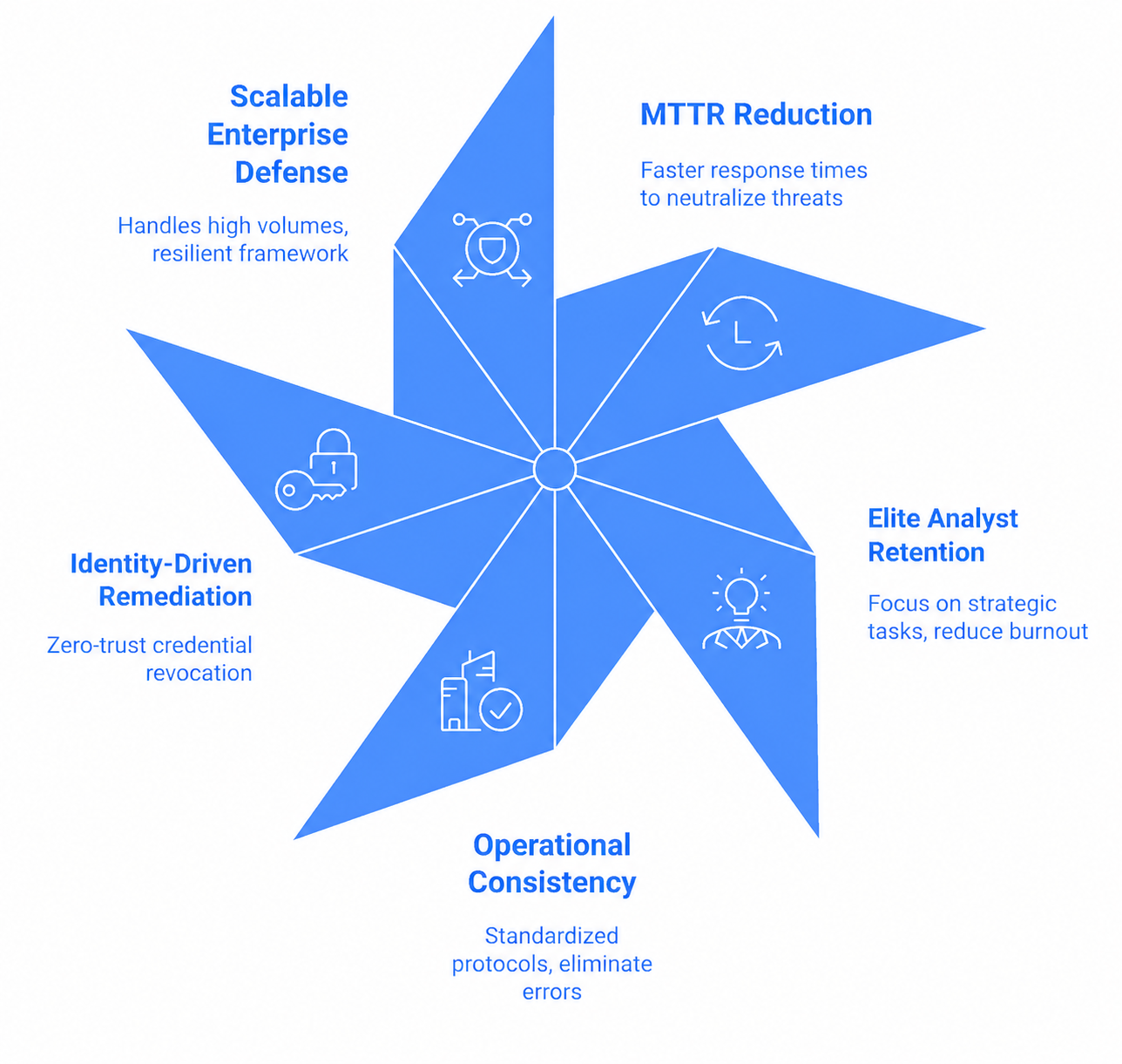
- MTTR Reduction: By substituting manual triage with automated, machine-speed playbook execution, security leadership can anticipate a dramatic compression of the mean time to respond, neutralizing active adversaries before critical enterprise data is successfully encrypted or exfiltrated.
- Elite Analyst Retention: The planned orchestration layer intends to eradicate the repetitive, soul-crushing manual tasks that plague tier-one analysts, allowing your highly compensated security personnel to focus their expertise exclusively on strategic threat hunting and complex vulnerability remediation.
- Uncompromising Operational Consistency: By rigorously codifying incident response protocols into inflexible, automated playbooks, the engine guarantees that every security event is handled precisely according to organizational policy, eliminating the costly variations caused by human error or analyst fatigue.
- Seamless Identity-Driven Remediation: Integrated directly with identity governance platforms like Sath IDHub, this architecture ensures that threat containment transcends basic network isolation, providing a verifiable, zero-trust mechanism for instantly revoking compromised credentials and halting internal lateral movement.
- Scalable Enterprise Defense: The automated response capabilities are designed to effortlessly handle massive volume spikes in malicious activity, providing Chief Information Security Officers with a highly resilient operational framework that scales to protect the enterprise without requiring proportional increases in headcount.
Regulatory Breach Response: From Incident to Evidence Package
Turning response automation into regulatory compliance at the moment it matters most.
Data protection and security regulations have progressively tightened the operational obligations that follow a confirmed security incident. GDPR and UK-GDPR impose 72-hour breach notification windows. PCI-DSS v4.0 mandates immediate containment evidence and forensic preservation. SOX requires demonstrable controls over access to financial systems at the time of the incident. Each obligation requires not just that the incident was managed—but that the management can be proven.
The Automated Incident Response layer is designed so that compliance evidence is a byproduct of the response workflow itself, not a parallel documentation exercise.
Regulatory posture commitments (planned):
- GDPR / UK-GDPR: Automated incident timeline generation and evidence packaging designed to support the 72-hour supervisory authority notification obligation; IDHub integration provides the identity access log that regulators require in breach investigations.
- PCI-DSS v4.0: Containment action logs, forensic preservation documentation, and cardholder data environment access records assembled automatically at incident closure.
- SOX: Automated audit trail of all access to financial systems during the incident window, cross-referenced with IDHub access governance records, for Audit Committee and external auditor review.
- ISO/IEC 27001:2022: Incident response process documentation aligned to Annex A controls for incident management, evidence handling, and continual improvement.
- HIPAA (Healthcare applicability): Breach analysis evidence generation and containment documentation designed to support HHS notification workflows for covered entities. [Planned]
- FFIEC / GLBA: Identity access containment records and incident response workflow documentation designed to meet financial services regulators' expectations for incident management maturity.
Identity Response Advantage: Containment That Reaches the Attack Vector
How Sath's native identity governance integration transforms response authority—and why it matters architecturally.
In the architecture of modern enterprise attacks, the identity layer is not merely a threat signal—it is frequently the attack mechanism itself. Adversaries compromise credentials and operate as legitimate users precisely because response systems are rarely given direct, programmatic authority over the identity layer. Revoking a compromised account through a SOAR platform historically meant triggering a webhook that called an IAM API that required a provisioned service account with the correct permissions—a chain of dependencies that introduces latency, failure points, and governance complexity at the worst possible moment.
Sath's approach eliminates that dependency chain. When the response layer needs to revoke a credential, suspend an account, terminate active sessions, or roll back access to a prior permission baseline, it calls IDHub's response APIs directly—as a first-class playbook action, with no external orchestration layer, no separate ticketing process, and no out-of-band IAM workflow.
This integration creates response capabilities that bolted-on SOAR platforms structurally cannot replicate:
- Containment that addresses root cause: Most credential-based attacks are contained at the network or endpoint—but the compromised credential that enabled the attack often remains active. IDHub integration ensures credential revocation is part of containment, not an afterthought.
- Graduated identity response: Not every identity incident warrants full account suspension. The response layer can escalate through graduated steps—forcing step-up MFA first, restricting sensitive system access second, and executing full suspension only if the graduated measures are insufficient or bypassed.
- Post-incident identity hygiene automation: Once an incident involving a compromised account is formally closed, the response layer automatically triggers an IDHub access recertification workflow to re-validate the affected user's full access posture before any access is restored—ensuring that incident closure and access hygiene are architecturally linked.
- Audit-complete identity response records: Every identity action taken during a response sequence—who was suspended, when, by which playbook, approved by which analyst—is recorded in IDHub's governance audit log, creating a single, authoritative identity response record for compliance and legal review.
Operationalizing The Response Layer: Target Use Cases
The Automated Incident Response layer is engineered to address the following high-frequency, high-consequence enterprise incident types where response speed and coordination quality most directly determine business outcome.
Ransomware Pre-Detonation Containment When the detection engine identifies ransomware staging behavior—file enumeration, shadow copy deletion, lateral encryption preparation—the response layer is designed to execute immediate endpoint isolation, block command-and-control communication, and suspend the compromised account via IDHub before the encryption payload activates. Speed is the entire containment variable in this scenario.
Business Email Compromise (BEC) & Phishing Response Automated playbooks engineered to quarantine the phishing message from all affected inboxes retroactively, revoke credentials for accounts that interacted with credential-harvesting links, block malicious sender domains, and notify impacted users—executing the full response sequence in a fraction of the time required for manual analyst intervention.
Privileged Account Compromise & Lateral Movement Containment When a privileged account or service account shows indicators of compromise, the response layer can suspend the account via IDHub, isolate connected endpoints, revoke active authentication sessions, and trigger an emergency access review for the account's full permission set—containing the lateral movement risk before the attacker can escalate to critical systems.
Cloud Misconfiguration & Unauthorized Access Response Automated response workflows designed to revoke over-permissive cloud IAM policies, isolate affected cloud workloads, and document the misconfiguration state at time of detection for forensic and compliance purposes—addressing the unique speed requirements of cloud-native incident response.
Insider Threat & Data Exfiltration Containment Coordinated response playbooks that suspend access via IDHub, preserve forensic artifacts, restrict outbound data paths, trigger a formal access certification review, and package evidence in the structured format required for HR, legal, and law enforcement engagement.
Regulatory Incident Response Workflow Activation For incidents that cross defined materiality thresholds—potential data subject exposure, confirmed cardholder data access, or financial system intrusion—automated workflows that immediately invoke the organization's regulatory notification runbook, notify the designated legal and compliance stakeholders, and begin assembling the structured evidence package the notification requires.