Investigation Forensics
Every security incident creates two demands: stop the threat, then understand it completely. Containment addresses the first. The second requires a different capability. Investigation & Forensics layer, the structured analytical investigation surface within the SIEM & XDR platform, is engineered to reconstruct cross-domain attack narratives with forensic precision, attribute actions to governed identities at specific historical moments, and produce legally defensible evidence that satisfies regulators, courts, and underwriters.
The Gap Detection and Response Leave Behind
After containment is declared, the investigation clock starts — from multiple directions simultaneously. Legal counsel needs to know whether privilege protections attach to the investigation record and whether the evidence was handled in a manner that withstands adversarial external review. The board wants to understand how the attacker entered, how long they had access, which systems and data they reached, and what the organization must change. Regulators — under GDPR Article 33(3), PCI-DSS, DORA, and SEC Form 8-K — want documented evidence that the incident was understood and bounded with forensic precision: not merely that an incident was detected and contained, but that its scope was determined, its root cause was established, and its accountability can be demonstrated to a standard that survives external scrutiny. Insurers want a structured forensic reconstruction to validate the scope of the claim. Law enforcement, if engaged, requires an evidence record that satisfies chain-of-custody standards their examiners will test.
Most enterprise security organizations cannot answer these demands from the systems that detected and contained the incident. Detection platforms produce alerts. Response platforms produce action logs. Neither produces the integrated, chronologically precise, multi-source investigation record that forensic accountability requires. Instead, organizations default to manual forensic assembly: querying disconnected systems, correlating timestamps across incompatible log formats, and reconstructing an attack narrative under time pressure, with incomplete data retention, and without a unified view of the full attack path.
The consequences of this gap extend beyond the immediate incident. Incomplete root-cause determination means attack vectors remain open after remediation. Imprecise scope analysis means affected data subjects go unnotified when notification was legally required — and over-notification exposes the organization to disclosure costs and credibility damage when it was not. Weak evidence records mean regulatory proceedings and civil litigation proceed from a position of organizational disadvantage.
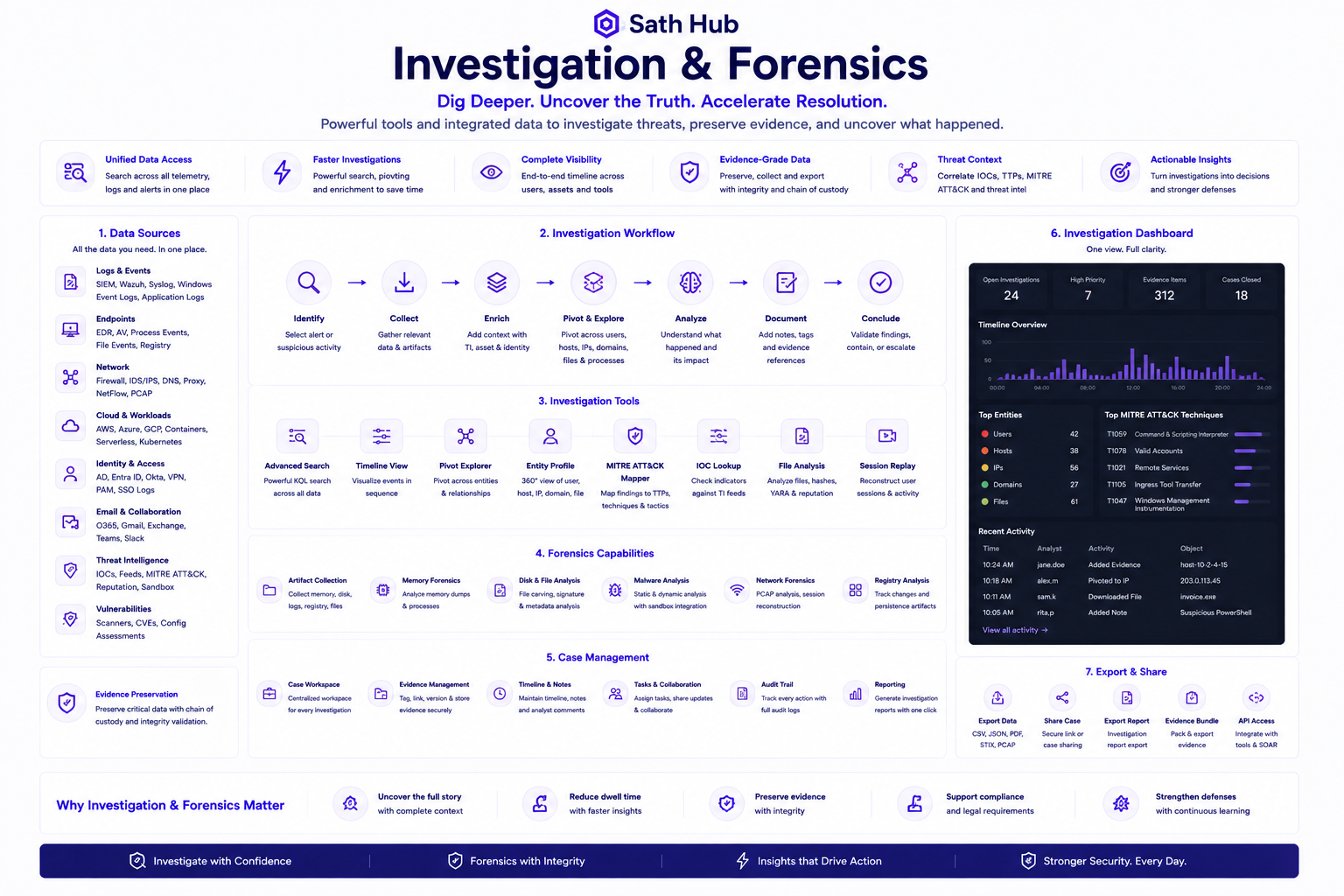
Sath's Investigation & Forensics layer is engineered to close this gap — purpose-built for cross-domain attack reconstruction, legally defensible evidence handling, structured threat hunting, and forensic reconstruction of identity governance states at any historical point in time.
The SIEM & XDR Platform's Accountability Layer
The Sath SIEM & XDR platform operates as four distinct, purpose-built layers. Each performs a function the others structurally cannot, which is described below:
Unified Security Telemetry
Ingests, normalizes, and stores event data from all sources at enterprise scale.
Core Question Answered: Do we have the data?
Real Time Threat Detection
Applies behavioral models and correlation logic to produce high-confidence threat signals.
Core Question Answered: Is something wrong?
Automated Incident Response
Executes playbooks, containment actions, and identity responses on confirmed incidents.
Core Question Answered: What did we do about it?
Investigation & Forensics
Reconstructs what happened, attributes it with forensic precision, and produces legally defensible evidence.
Core Question Answered: What exactly occurred, and can we prove it?
Investigation & Forensics is the analytical accountability layer: the component that receives all event data, investigation artifacts, and incident records from the platform's other layers and performs the structured analytical work of forensic reconstruction, threat hunting, and evidence management that no detection or response function performs.
The distinction is architecturally precise. Detection is optimized for sensitivity—erring toward surfacing signals. Response is optimized for speed and precision of action. Investigation is optimized for evidentiary completeness—assembling the record that withstands external scrutiny from parties who were not present during the incident and who will question every assumption.
Investigation & Forensics Capabilities
Cross-Domain Attack Narrative Reconstruction
The Investigation & Forensics layer assembles a single authoritative, sub-second-resolved forensic timeline from every data domain the platform covers—endpoint, network, cloud API, email, identity—answering the post-containment accountability question that neither detection nor response was designed to produce: what did the attacker do, in what precise sequence, across every system they touched, from the moment of first access to the moment containment was declared.
Unified cross-domain forensic timeline resolving events from all covered data sources to a single chronological record with sub-second event sequencing—distinct from the detection engine's correlation output in that it is assembled for accountability and evidence purposes, not for alert generation, and covers the complete confirmed compromise window rather than the real-time event stream
Attacker decision reconstruction sequencing the adversary's operational choices—which systems they targeted in what order, which access paths they chose and which they abandoned, where they paused and for how long—as a documented behavioral record within the forensic timeline, providing the narrative context that neither an alert log nor a containment action record produces
Data interaction inventory identifying every file, database table, cloud storage object, email account, or application record the attacker queried, staged, copied, or modified during the confirmed compromise window, mapped to the specific timestamp and system on which each interaction occurred [Planned]
Compromise phase segmentation breaking the full dwell window into discrete, timestamped operational stages—initial foothold establishment, internal network reconnaissance, privilege condition staging, cross-system traversal, and data interaction—with the specific events and evidence attributable to each phase documented separately for regulatory scope-determination purposes [Planned]
Multi-domain event stitching that resolves the same attacker action expressed as separate events across multiple data sources—an authentication in the identity log, a process spawn in the endpoint record, a network connection in the flow log—into a single unified event entry with evidence from all contributing sources, eliminating the manual cross-referencing that produces investigative gaps under time pressure
Annotated forensic timeline export producing a structured, independently navigable investigation record—with full event provenance, source attribution, and confidence notation—suitable for handoff to legal counsel, external forensic reviewers, regulatory examiners, or law enforcement without requiring the receiving party to access the platform directly [Planned]
Forensic Evidence Integrity & Legal Chain of Custody
The Investigation & Forensics layer enforces the specific evidence handling standards—cryptographic integrity preservation, tamper-evident storage, legally controlled access, and documented acquisition provenance—that determine whether the investigation record survives independent adversarial scrutiny from parties who were not present at the incident: courts, regulatory examiners, opposing counsel, insurance adjusters, and external forensic experts who will specifically test whether the evidence was preserved in accordance with legal admissibility requirements, not merely whether the underlying data is complete.
Cryptographic hash generation applied to each evidence record at the moment of collection, creating a mathematically verifiable baseline that allows any external party to independently confirm at any future point that a specific record is identical to its state when originally collected—without relying on any organizational assertion or system log to establish that integrity
Legal hold designation—the ability to place specific investigation records, event time windows, or data source outputs under a named, immutable hold that suspends all automated data lifecycle management, blocks modification or deletion by any system process or privileged user, and persists independently of case status changes until the hold is formally released by an authorized party with documented justification [Planned]
Evidence access provenance log capturing every interaction with a held or designated evidence record: which analyst accessed it, from which authenticated session, at what precise timestamp, and for which named investigation—itself stored under tamper-evident conditions so that the log of who touched the evidence is as legally defensible as the evidence itself
Forensic acquisition package generation producing a complete, court-ready evidence artifact that combines the underlying event data, its cryptographic integrity hash at collection, the chain-of-custody log, and an annotated investigation narrative—structured to satisfy the documentation standards that law enforcement referral, civil litigation discovery, and regulatory examination require from electronically stored evidence [Planned]
Independent integrity verification capability enabling any authorized party—including external reviewers with no platform access—to verify the bit-for-bit integrity of a produced evidence package against its original collection hash, demonstrating that nothing in the record was altered between collection and the moment of external review
Analyst investigation action log recording every query executed, every annotation created, every record bookmarked, and every export performed during the investigation—with analyst identity, session credentials, timestamp, and the named investigation record to which each action was attributed—creating a complete, tamper-evident procedural record of the investigation methodology itself, separate from the evidence content [Planned]
Threat Hunt Program Governance & Investigation Accountability
The Investigation & Forensics layer provides the governance and accountability infrastructure for structured threat hunting programs—formal hypothesis lifecycle management, persistent multi-session hunt workspaces with complete analytical lineage, hunt program audit records that document which adversary techniques have been actively tested and by whom, and the investigative rigor controls that distinguish a defensible, auditable hunting program from ad hoc analyst querying conducted without documented methodology or organizational accountability.
Formal hypothesis documentation framework enabling investigators to record the specific adversary technique, behavioral pattern, or infrastructure characteristic under investigation, the evidence required to confirm or refute the hypothesis, and the conclusion reached—creating an auditable analytical record that survives analyst turnover and satisfies the documentation requirements that security program auditors and regulatory examiners apply to proactive security activities [Planned]
Persistent hunt session workspace that preserves the complete state of an active investigation across multiple analyst sessions and calendar days: every query structure, every evidence record reviewed, every interim finding noted, and every analytical decision made—so that a hunt requiring two weeks of intermittent investigation accumulates a continuous, unbroken analytical record rather than a collection of disconnected session exports
Multi-analyst hunt contribution governance allowing multiple investigators to work within the same named hunt workspace with full per-contributor attribution: every query, annotation, and finding permanently associated with the analyst who produced it, with a version history of the workspace's evolution—enabling collaborative investigation without sacrificing the individual accountability that legal and compliance review requires
Hunt closure documentation producing a formal investigation conclusion record for every completed hunt, regardless of outcome: the original hypothesis, the evidence examined, the analytical path taken, and the stated conclusion—archived with the same integrity controls as forensic evidence records, so that a "no finding" conclusion is as formally documented and retrievable as a confirmed threat discovery [Planned]
Hunt program coverage register—an organizational-level record of which adversary technique classes, behavioral patterns, and infrastructure indicators have been formally hunted, by which team members, during which time windows, with what data coverage, and with what documented conclusions—providing security leadership with an auditable account of proactive hunting program activity for board reporting, cyber insurance assessment, and regulatory program maturity demonstration [Planned]
Investigation integrity controls preventing unattributed modification of an active hunt workspace: all changes to hypothesis statements, analytical conclusions, or evidentiary designations require authenticated analyst action and are version-controlled, ensuring that the investigation record reflects what was actually found rather than a post-hoc reconstruction shaped by knowledge of the incident's outcome
Point-in-Time Identity Governance Reconstruction via IDHub
By querying IDHub's historical governance record retroactively, the Investigation & Forensics layer reconstructs the exact entitlement inventory, role assignments, certification status, and access lifecycle event history of any user at any specified past timestamp—producing the forensic answer that real-time identity binding and real-time entitlement correlation structurally cannot provide: not what a user's access profile is now, and not what it was flagged as during the incident, but what the governance record formally shows it was at the precise historical moment the suspicious activity occurred.
Historical entitlement snapshot query producing the complete, IDHub-sourced access entitlement inventory held by a specified user at any past timestamp—the exact set of systems, applications, and data classes to which that user held formally recorded authorization at the moment under investigation, reconstructed from the governance record as it existed at that time rather than as it exists today after subsequent modifications, removals, or re-certifications may have altered it
Certification state reconstruction at investigation timestamp—determining whether each entitlement the user held at the time of the suspicious event had been formally reviewed and approved within the current certification cycle, was pending review but had not yet been assessed, or had been flagged for revocation but not yet formally deprovisioned—a distinction that determines whether a governance control functioned as designed or failed at the certification stage [Planned]
Access lifecycle event sequence for a specified identity and time window—the chronological record of every provisioning action, role modification, certification review, privilege change, and deprovisioning instruction recorded in IDHub for that identity in the period surrounding the investigation window—enabling investigators to determine whether access changes coincided with, immediately preceded, or followed the suspicious activity under examination
Historical over-provisioning determination identifying, at the specific past timestamp under investigation, whether the user held entitlements to systems they accessed during the compromise window that exceeded their documented business-need authorization at that time—a governance failure characterization that differs from current over-provisioning detection in that it establishes what the governance record shows was true at the moment of the event, not what has been corrected or removed since [Planned]
Governance process exception identification at investigation time—surfacing whether any access grants, role assignments, or permission modifications held by the user at the investigation timestamp were processed outside normal approval workflows, lack required authorization documentation in the IDHub record, or were added through exception channels that bypass standard certification requirements
Historical identity governance evidence package assembling the IDHub record for a specified user and time window—entitlements held, certification states, lifecycle event sequence, and any exception conditions—into a structured, exportable forensic artifact with the same integrity controls applied to all investigation evidence, suitable for regulatory submission, legal hold, breach notification scope determination, and external auditor review [Planned]
Malicious Artifact & Indicator Production
When investigation surfaces a suspicious file, script, binary, memory sample, or network communication record, the Investigation & Forensics layer provides the analytical workspace to characterize that artifact from first principles—extracting its structural properties, documenting its observable behaviors, deriving shareable indicators, and creating detection-ready rules from it—producing threat intelligence as an output of the investigation process, in direct contrast to the detection layer's function of consuming externally sourced threat intelligence as an input to alert generation.
Structural artifact characterization extracting the static properties of confirmed malicious files and scripts: cryptographic hashes across MD5, SHA-1, and SHA-256 algorithms; embedded string content and decoded URL references; imported library and API call profiles; and code signing certificate validity—producing a documented artifact profile that serves as the authoritative technical record of the specific malicious object encountered in this investigation
Command-and-control infrastructure documentation recording and analyzing network indicators identified in the investigation: IP addresses, domain names, URL patterns, and port and protocol characteristics observed in telemetry associated with the confirmed malicious artifact, enriched with passive DNS history and registration timing context to support attribution of infrastructure to known adversary clusters or campaigns [Planned]
YARA rule authoring from confirmed artifact characteristics—developing detection rules based on the structural and behavioral signatures of artifacts confirmed as malicious during investigation, validated against the forensic data store to confirm detection precision and false-positive rate before submission for production deployment in the platform's detection rule library [Planned]
Indicator export in STIX 2.1 format structuring the investigation-derived IOCs—file hashes, network indicators, behavioral patterns, and infrastructure characteristics—in the standard structured format required for sharing with sector ISAC partners, external threat intelligence platforms, law enforcement referral packages, or the organization's own detection engineering team for integration into production detection logic
Artifact origin tracing establishing where a confirmed malicious artifact was first introduced into the environment: the specific endpoint that received it, the process chain and parent process through which it arrived, the network source from which it was delivered, and whether the same artifact or a structurally similar variant appeared at other locations in the estate before or after the first confirmed instance—documenting the introduction event as an investigation finding separate from the attack narrative reconstruction [Planned]
Investigation-to-intelligence lineage record—the structured documentation of how a specific artifact encountered during a named investigation was characterized, which indicators were extracted and operationalized, what adversary infrastructure or campaign those indicators attributed to, and which detection rules or threat intelligence records were created as a downstream result—preserving the analytical provenance chain from raw discovery through operational deployment for program accountability and future reference
Root Cause Attribution & Residual Access Determination
The Investigation & Forensics layer is designed to support the structured analytical work of establishing the verified initial access vector, characterizing precisely where and why each security control in the attacker's path did not function as intended, producing a complete inventory of every mechanism the attacker established to maintain or re-establish access during the dwell period, and confirming with documented evidence that each of those mechanisms has been eliminated before the organization's leadership is asked to attest—to regulators, insurers, a board, or a court, that the incident has been fully resolved.
Initial access vector determination tracing the complete attack path in reverse from the earliest confirmed attacker action to the original entry point—whether that is a specific CVE exploited against an internet-facing service, a credential obtained through phishing or purchased from an initial access broker, a misconfigured cloud storage permission, or a supply chain artifact introduced through a trusted vendor update—documented with the specific events, timestamps, and source evidence supporting the attribution conclusion
Stage-by-stage security control failure characterization identifying, at each documented stage of the reconstructed attack path, the specific security control that was architecturally positioned to detect or prevent the attacker's action and the precise failure mode that allowed the action to proceed—categorized as a coverage gap (the control did not extend to that environment), a configuration error (the control was present but misconfigured), a tuning deficit (the control's sensitivity thresholds did not capture this signal class), or an architectural limitation (the control's design cannot address this technique class) [Planned]
Attacker persistence mechanism inventory—a systematic, evidence-referenced enumeration of every method the attacker installed or modified to maintain or re-establish access during the dwell period: scheduled tasks, registry run-key modifications, installed services, created or modified accounts, implanted API keys, modified cloud IAM role bindings, and backdoored application configurations—with the specific event evidence supporting identification of each mechanism and the confirmed remediation status of each entry
Residual access path assessment—a structured post-containment examination conducted as a formal pre-closure step, evaluating whether any access credential, cloud role binding, service account configuration, or persistence mechanism established or modified during the confirmed compromise window remains in a state that would permit re-entry, regardless of whether that access path was included in the response layer's executed containment playbook
Security control gap documentation producing a structured report—formatted specifically for security architecture and investment decision use—identifying each confirmed control failure by stage, categorizing the failure mode, specifying what architectural or configuration change would address it, and noting which regulatory framework requirements the gap implicates: providing security program leadership with the evidence-based analytical input that post-incident investment decisions require, rather than vendor recommendations applied to a qualitatively described incident [Planned]
Pre-closure investigation verification confirming, before the investigation record is formally closed and organizational leadership is asked to attest to incident resolution, that five specific forensic conditions are satisfied and documented with evidence: the initial access vector is attributed with supporting evidence, the persistence mechanism inventory is complete with confirmed remediation status for each entry, the residual access path assessment has found no viable re-entry condition, all affected user accounts have completed an IDHub access recertification, and the regulatory notification obligation assessment has been formally documented—creating an evidence-based closure attestation rather than a workflow milestone
The Question This Layer Is Built to Answer
The platform's other layers each answer a question that makes the next layer's function possible. The telemetry layer answers: Do we have the data? The detection engine answers: Is something wrong? The response layer answers: What did we do about it? The correlation layer answers: Which events belong to the same identity thread? Together, these four questions define what the organization knew and did during an incident.
They do not answer the question that arrives after containment is declared — from parties who were not present during the incident, who are specifically motivated to challenge the organization's account of what occurred, and who operate under legal standards of evidence that security operations platforms were not designed to satisfy:
Can you demonstrate — with documented, independently verifiable evidence — precisely what the attacker accessed, when they accessed it, how they obtained that access, whether the identities they operated under held governance-approved authorization for the systems they reached at the precise moment they reached them, and whether every mechanism they installed to maintain that access has been identified, documented, and confirmed eliminated — before your leadership attests that the incident is resolved?
This is the forensic accountability question. It is asked by courts, regulatory examiners, insurance adjusters, opposing counsel, and supervisory authorities — all of whom scrutinize the investigation record from a presumption of challenge rather than a presumption of good faith.
Detection is optimized for sensitivity: it errs toward surfacing signals. Response is optimized for speed and decisiveness of action. Forensic investigation is optimized for evidentiary completeness: every conclusion must be independently verifiable by an external examiner who did not witness the incident and who has no obligation to accept the organization's account of it.
The Investigation & Forensics layer is built to produce that evidentiary completeness — not because the underlying incident data happens to be adequate, but because the investigation architecture was designed for adversarial external review from the outset.
Executive Security Value
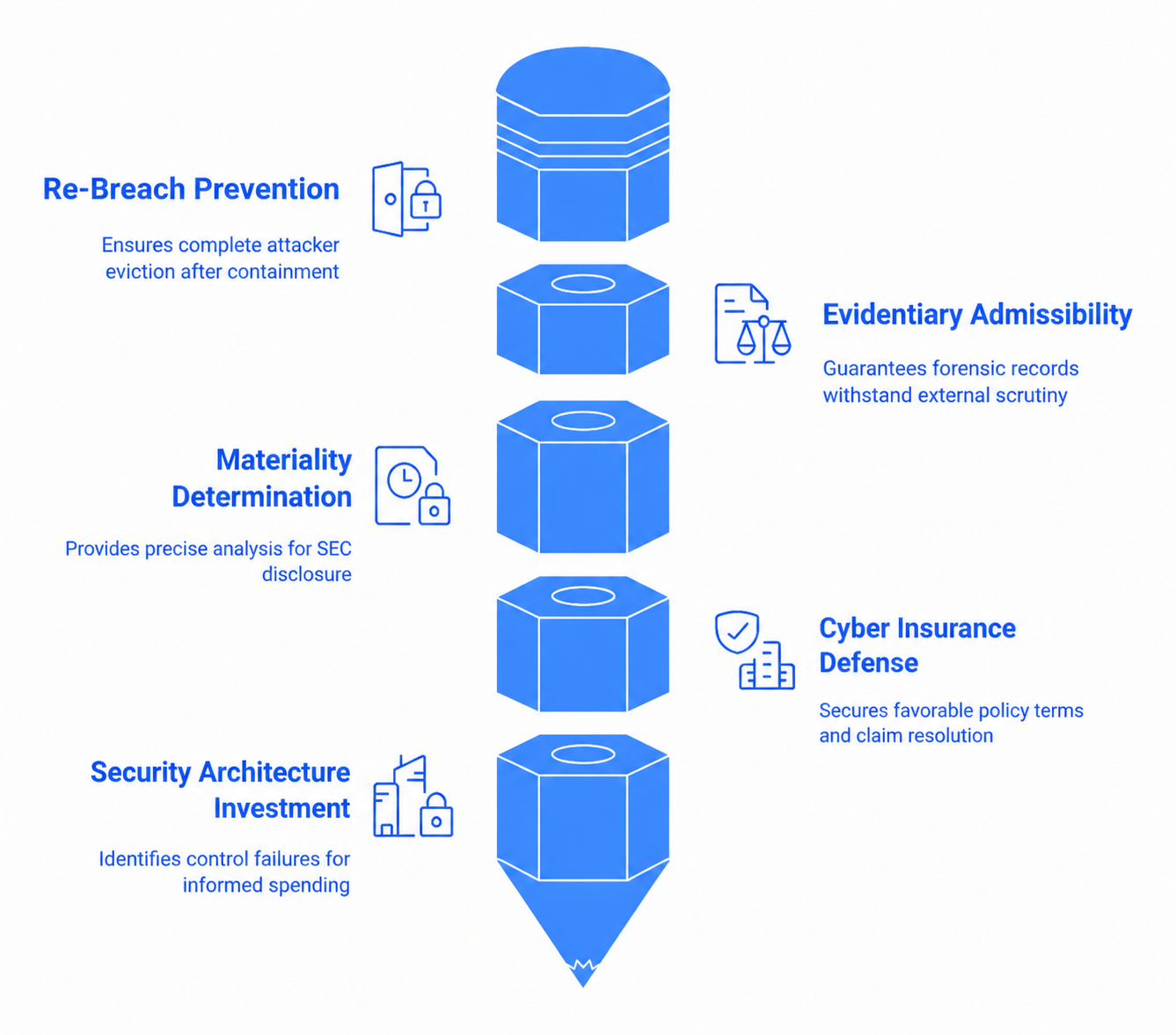
Re-Breach Prevention Through Systematic Residual Access Verification
Containment closes the attack vector the response playbook identified. It does not automatically eliminate every persistence mechanism installed, every credential modified, and every access path staged during the full dwell period—particularly when the attacker operated for weeks before the first detection trigger. The gap between declared containment and complete attacker eviction is not a response execution failure; it is a structural consequence of response systems being designed to act on confirmed indicators rather than enumerate what was done across an entire compromise window. Closing an incident without a documented residual access determination means the organization's leadership is attesting to resolution based on the absence of known indicators, not the presence of verified evidence. The Investigation & Forensics layer produces that verification as a formal pre-closure step: a structured enumeration of every persistence mechanism identified, every credential touched, and every access path traversed—cross-referenced against the response layer's executed containment actions to confirm which have been addressed and which require additional remediation before the incident can be closed with evidence-backed confidence.
Evidentiary Admissibility Under Independent External Scrutiny
The quality of a forensic event record and the legal admissibility of that record are separate properties that require different architectural decisions. A high-fidelity, complete event record satisfies the investigator's analytical needs. Whether that same record satisfies the evidentiary standards of a court proceeding, a regulatory examination, or an insurance dispute—conducted by parties who were not present at the incident and who are specifically motivated to challenge the record's integrity—requires that the record was handled according to standards designed for adversarial external review. These standards are procedural and architectural: cryptographic hashing at collection to create a verifiable integrity baseline, immutable acquisition logging that documents every analyst interaction with the record, legal hold enforcement that suspends automated retention policies and prevents any system process from modifying or deleting evidence under hold, and tamper-evident storage that allows an independent examiner to verify bit-for-bit integrity at any future point without relying on organizational attestation. The Endpoint Threat Visibility layer addresses the quality and completeness of the event record as a monitoring output. The Investigation & Forensics layer addresses whether that record survives independent adversarial scrutiny—a requirement that only materializes when external parties examine it, and cannot be retrofitted after the fact.
Materiality Determination Precision Under the SEC's Four-Business-Day Clock
The SEC's Form 8-K Item 1.05 disclosure obligation does not run from the moment of incident discovery or containment. It runs from the moment the organization determines the incident is material—and that determination must be made without unreasonable delay following discovery. The determination itself is a forensic investigation output: characterizing the nature, scope, and timing of the incident with the analytical precision that supports a defensible judgment about whether a reasonable shareholder would consider it important. Detection alerts establish that an incident occurred. Response records establish what the organization did about it. Neither produces the cross-domain forensic reconstruction of what the attacker accessed, which systems they reached, for how long they had access, and whether that access extended to data or operations with material financial, reputational, or operational consequences. Organizations that cannot perform structured forensic analysis from the moment of containment face a materiality determination process conducted under time pressure without the evidentiary foundation the determination requires—producing either an over-cautious premature disclosure or an under-informed delayed one. The Investigation & Forensics layer is designed specifically to produce the analytical output the materiality determination requires, at the speed the four-business-day clock demands.
Cyber Insurance Claim Defense Versus Underwriting Position
Cyber insurance creates two distinct evidence obligations that arise at different points in the policy lifecycle and require different documentation. The first—securing favorable policy terms and coverage eligibility—requires demonstrating to underwriters that continuous monitoring coverage is active across all managed endpoints. The Endpoint Threat Visibility layer's continuous asset inventory and telemetry health records address that obligation directly. The second obligation arises after a breach when a claim is filed: demonstrating to the insurer, under adversarial review conditions, that the scope of the incident was bounded, that the root cause falls within the policy's covered peril definitions rather than an exclusion, and that remediation was complete enough to preclude coverage disputes based on failure to mitigate. These are forensic investigation documentation requirements, not monitoring coverage requirements. Claims are disputed and reduced on three specific grounds: inability to demonstrate actual data exposure scope, root cause attribution to a condition that triggers a policy exclusion, and incomplete remediation that insurer counsel argues allowed loss to continue. The Investigation & Forensics layer produces the three structured forensic outputs that address each ground: the cross-domain attack narrative establishing scope, the root cause attribution report establishing the access vector and its relationship to policy definitions, and the residual access determination confirming remediation completeness before claim submission.
Security Architecture Investment Accountability Through Evidence-Based Failure Analysis
Every material security incident is also a natural experiment in which specific security controls were tested under real adversarial conditions and their failure modes became observable. The question for security program leadership is whether the organization can read those results with enough precision to make investment decisions from them—or whether the post-incident review produces a qualitative narrative about what should have worked, without the analytical specificity to identify what architectural or configuration decision actually failed at each stage. Control failure analysis in the Investigation & Forensics layer is not a retrospective commentary on the incident. It is a structured output mapped to the reconstructed attack path: at each stage of the attacker's documented movement, which control was in position, what the control should have done, what it actually did, and what specific architectural gap, tuning deficit, configuration error, or coverage limitation produced the outcome observed. The resulting control gap report is an evidence-based investment brief—identifying where remediation spending addresses a documented, observed failure versus where it addresses theoretical risk. Security program leaders who take that document to a budget conversation, an audit committee, or a cyber insurer's risk assessment are making a materially different argument than those who cannot.
Forensic Investigation Obligations: The Regulatory Accountability This Layer Is Uniquely Positioned to Address
These are not the monitoring and breach notification obligations addressed by the detection and response layers. These are the forensic investigation and reporting obligations that regulators impose on what organizations must understand and prove about incidents that have already occurred.
SEC Form 8-K Item 1.05 — Material Incident Disclosure: Under the SEC's rules, Item 1.05 of Form 8-K requires public companies to disclose material cybersecurity incidents within four business days of determining that the incident is material. The disclosure must contain the nature, scope, and timing of the incident and the impact or reasonably likely impact of the incident on the company, its financial condition, and its results of operations. The determination of materiality—and the ability to describe "nature, scope, and timing" with precision—requires forensic investigation capability. A detection alert establishes that something occurred. A forensic investigation determines whether it was material, what its scope was, and when it began. The Investigation & Forensics layer is designed to produce the analytical output that materiality determinations require, at the speed the four-business-day clock demands. [Planned alignment] GetodenPalo Alto Networks
DORA (EU Digital Operational Resilience Act) — Final ICT Incident Report: Root-Cause Determination and Corrective Measures: DORA's incident reporting framework requires EU-regulated financial entities to submit three structured reports on major ICT-related incidents. The initial notification and intermediate report address incident identification and evolving response status — obligations whose evidence basis is produced by the detection and response layers. The final report imposes a distinct analytical obligation that those layers structurally cannot satisfy: it requires root-cause determination, assessment of actual and potential impacts, and documentation of corrective measures taken or planned to prevent recurrence. This is a forensic investigation output, not a detection or response output. The root cause attribution capability is designed to produce the evidence-grounded root-cause determination that DORA's final report requires. The control gap documentation output directly addresses the corrective measures analysis that the final report's lessons-learned obligation demands. This obligation is distinct from DORA Article 9's ICT access rights management requirements — addressed by the Identity Aware Correlation layer — which concern continuous access governance rather than post-incident forensic investigation and reporting.
PCI-DSS v4.0 — Mandatory Payment Card Industry Forensic Investigator (PFI) Engagement: When a PCI-DSS-scoped breach involves potential cardholder data compromise, the standard requires engagement of a PCI-qualified forensic investigator. The quality of the organization's internal investigation record—the completeness of the attack timeline, the integrity of evidence preservation, and the scope determination of affected systems—directly determines the time, cost, and scope of the mandatory PFI engagement. Organizations with a structured forensic investigation platform are materially better positioned in a PFI engagement than organizations relying on manual log assembly.
GDPR Article 33(3) — Supervisory Authority Notification: Forensic Scope Determination as the Precondition for Accurate Content: GDPR's supervisory authority notification obligation has two distinct dimensions that belong to different platform layers. The notification process — the 72-hour timeline, the initiation of the notification, and the evidence packaging that supports it — is addressed by the Automated Incident Response layer's regulatory workflow. The notification content that Article 33(3) specifies is a forensic investigation obligation: the nature of the breach, the categories of personal data involved, the approximate number of data subjects concerned, and the likely consequences for individuals affected. These are not operational response outputs — they are forensic scope determination outputs. Supervisory authorities that contest the scope of a filed notification are contesting the quality of the forensic investigation that bounded it. Over-scoped notifications expose organizations to unnecessary regulatory and reputational cost; under-scoped notifications expose them to enforcement action for inadequate breach assessment. The cross-domain attack narrative reconstruction and point-in-time IDHub governance reconstruction capabilities are designed to produce the evidence-bounded scope determination that makes Article 33(3) notification content accurate and defensible under regulatory scrutiny.
ISO/IEC 27001:2022 Annex A.5.27 and A.5.28 — Evidence Collection Standards and Post-Incident Knowledge Application: ISO 27001:2022 Annex A.5.26 addresses the organizational response process for security incidents — the controls that the Automated Incident Response layer's process documentation is designed to satisfy. The Investigation & Forensics layer addresses two adjacent but structurally distinct Annex A controls. Annex A.5.28 requires that evidence collected during investigation be gathered using procedures that meet the standards for admissibility in the legal jurisdiction relevant to the intended use — meaning that collection methodology, integrity preservation, and chain of custody must satisfy standards designed for adversarial external review, not merely internal analytical purposes. The forensic evidence integrity and legal chain-of-custody capability is designed to embed these A.5.28 collection standards architecturally, so that every investigation record meets admissibility requirements by default rather than requiring separate forensic procedures to be applied retrospectively. Annex A.5.27 requires that knowledge gained from security incidents and near-misses be applied to reduce the likelihood or impact of future events — a requirement that demands more than a narrative post-incident review. The root cause attribution capability's structured control failure analysis and control gap documentation output produce the specific, evidence-based A.5.27 learning artifact: a documented assessment of which controls failed, under what conditions, and what architectural or configuration change addresses each failure.
Cyber Insurance Policy Forensic Requirements: Enterprise cyber insurance policies increasingly require forensic investigation documentation as a condition of claim validation. Incomplete investigation records—particularly the inability to demonstrate scope (what data was accessed), root cause (how the attacker entered), and remediation completeness (what was done to close the attack path)—are the primary basis for disputed or reduced claims. The Investigation & Forensics layer is designed to produce the structured forensic record that underwriters require for full claim validation.
The IDHub Forensic Governance Advantage: Knowing Not Just Who—But Who Had Permission at That Moment
Across the Sath SIEM & XDR platform, IDHub serves a structurally distinct function at each layer. On the Real Time Threat Detection engine, IDHub provides live identity governance events as a real-time telemetry source — lifecycle signals that the detection engine incorporates into alert scoring and behavioral correlation. On the Automated Incident Response layer, IDHub is the programmatic execution arm for credential and access containment: the system through which account suspension, credential revocation, and session termination execute as first-class playbook steps. On the Endpoint Threat Visibility layer, IDHub binds the authenticated user's current identity profile to endpoint telemetry events at the moment of collection, providing real-time identity attribution for each collected event. On the Identity Aware Correlation layer, IDHub functions as the correlation graph backbone — its entitlement graph provides the organizational access topology that structures the correlation model, and its canonical identity resolution record serves as the cross-domain joining key for organizing events across authentication source boundaries in real time.
None of those functions answer the forensic investigator's defining question.
The forensic question is not "who is this user now?" It is: "At 14:47 on the fourth of March, was this user authorized — formally, in the governance record — to access the system they accessed? Had that access been certified in the current review cycle? Were there any access lifecycle events in the period preceding that access that, in the governance record as it existed at that moment, should have triggered a review before the access was exercised?"
This is a retroactive forensic query — the temporal opposite of the operational correlation function the Identity Aware Correlation layer performs. The IAC layer uses governance lifecycle events as prospective anchors: when a governance change occurs, correlation sensitivity is elevated for what the identity does next. The forensic question operates in reverse: given an event that occurred at a specific past moment, reconstruct the governance record as it existed at that moment — not what it shows today, and not what the correlation layer observed prospectively — and determine from that historical record whether the access was authorized, certified, and consistent with organizational governance at the time it occurred. These are functions that require different architectural capabilities and produce different analytical outputs.
The specific questions cannot be answered from a real-time identity binding, from an operational correlation layer, or from the identity record as it currently exists after subsequent access modifications, revocations, or re-certifications have altered it. They require the ability to query the governance record retroactively, reconstruct the entitlement state as it existed at a precise past timestamp, and produce that reconstruction in an exportable format that external reviewers can evaluate independently.
The specific forensic advantages this creates are operational and regulatory:
- Breach notification scope determination: GDPR Article 33(3), the SEC Form 8-K Item 1.05 materiality framework, and DORA's incident reporting requirements all demand that the organization describe the scope of affected data and systems. Determining whether a user's access to a specific system was within their governance-approved entitlement at the time of the event is the analytical step that bounds that scope. The point-in-time reconstruction provides that bound.
- Insider threat investigation: When investigating whether an employee's access to sensitive data was unauthorized, the defense or prosecution of that determination rests entirely on the organization's ability to produce the governance record as it existed at the time—not as it exists after IT has removed the employee's access and the system shows only a historical change log.
- Certification failure accountability: Organizations with access recertification programs are increasingly held accountable—by auditors and regulators—for whether access that was reviewed and certified was actually appropriate at the time of certification. When a certified entitlement is later found to have enabled a breach, the ability to produce the certification record, the reviewer, and the timestamp transforms from an audit formality into a material legal document.
- Privilege escalation forensic attribution: When forensic investigation confirms that an attacker operated through an over-provisioned service account or that an identity accumulated access beyond its governance-authorized scope during the attack window, the operational identification of that over-provisioning belongs to the correlation layer's continuous monitoring function. The forensic question is different and temporally distinct: when was the over-provisioning introduced into the IDHub governance record, through which provisioning process and under whose authorization, whether it was presented to any certification reviewer before the incident, and whether the governance record reflects a systematic control gap — a failure of the review and remediation process to surface an access condition that should have been flagged — or a deliberate circumvention by an insider with governance access. The answers determine accountability at the governance-process level, not just at the access-event level, and those answers are frequently what regulatory investigators and opposing counsel pursue. Point-in-time governance reconstruction produces the historical record that answers these questions with documented evidence rather than post-incident inference.
Target Use Cases
The Investigation & Forensics layer is designed to address the following high-priority scenarios where the quality of forensic analysis directly determines legal, regulatory, and operational outcomes.
Breach Scope Determination for Regulatory Notification After containment, the legally consequential question is not whether a breach occurred, but which specific data subjects, records, and systems were actually within the attacker's reach. Over-notification carries regulatory and reputational cost; under-notification carries legal liability. The cross-domain attack narrative reconstruction and point-in-time IDHub governance reconstruction capabilities are designed to produce the scoped, evidence-bounded answer that regulators require.
Long-Dwell Attacker Reconstruction When threat intelligence or a successful hunt reveals that an adversary has been present for weeks or months without triggering alerts, the investigation challenge is reconstructing the full scope of their activity across that dwell period using the forensic data store's historical record. The persistent investigation workspace and forensic query engine are designed to support multi-week investigation programs that cannot be completed in a single analyst session.
Law Enforcement and Regulatory Referral Evidence Preparation Preparing a forensic evidence package for law enforcement referral or regulatory agency examination requires that the evidence record satisfies chain-of-custody standards that were not designed with security operations in mind. The forensic evidence integrity capability—cryptographic preservation, acquisition logging, tamper-evident storage—ensures the investigation record is admissible at the point of referral, not reconstructed under legal pressure after the fact.
Retroactive Compromise Assessment from New Threat Intelligence When newly published threat intelligence reveals that an indicator of compromise or adversary TTP was active in the threat landscape before the organization knew to look for it, the historical forensic data store enables backward investigation to determine whether that indicator appeared in the organization's environment during the relevant window—and whether undetected compromise occurred.
Post-Incident Security Program Failure Analysis After an incident is contained, the security program leadership conversation moves quickly to investment: what failed, what should be changed, and where should remediation budget be directed. Control failure analysis from the root cause attribution capability is designed to produce a structured, evidence-based assessment of which specific architectural and configuration decisions created the conditions the attacker exploited—transforming post-incident review from a subjective discussion into an evidence-based decision process.
Board and Regulatory Briefing Package Preparation Every material incident requires two simultaneous deliverables: a technically precise forensic investigation record for regulators and legal counsel, and an executive narrative for the board that translates forensic findings into business risk and remediation decisions without requiring the board to interpret raw evidence. The structured investigation record and export capabilities are designed to produce both from the same underlying investigation workspace, without requiring separate documentation processes.