Real Time Threat Detection
Enterprise security teams are losing the detection race. Adversaries now move from initial compromise to lateral spread in under four hours faster than most SIEM deployments correlate their first alert. The Real Time Threat Detection engine, the analytical core of Sath's SIEM & XDR platform, is architected to close that gap: ingesting cross-domain telemetry, correlating behavioral anomalies, and surfacing high-fidelity incidents before dwell time compounds into irreversible damage.
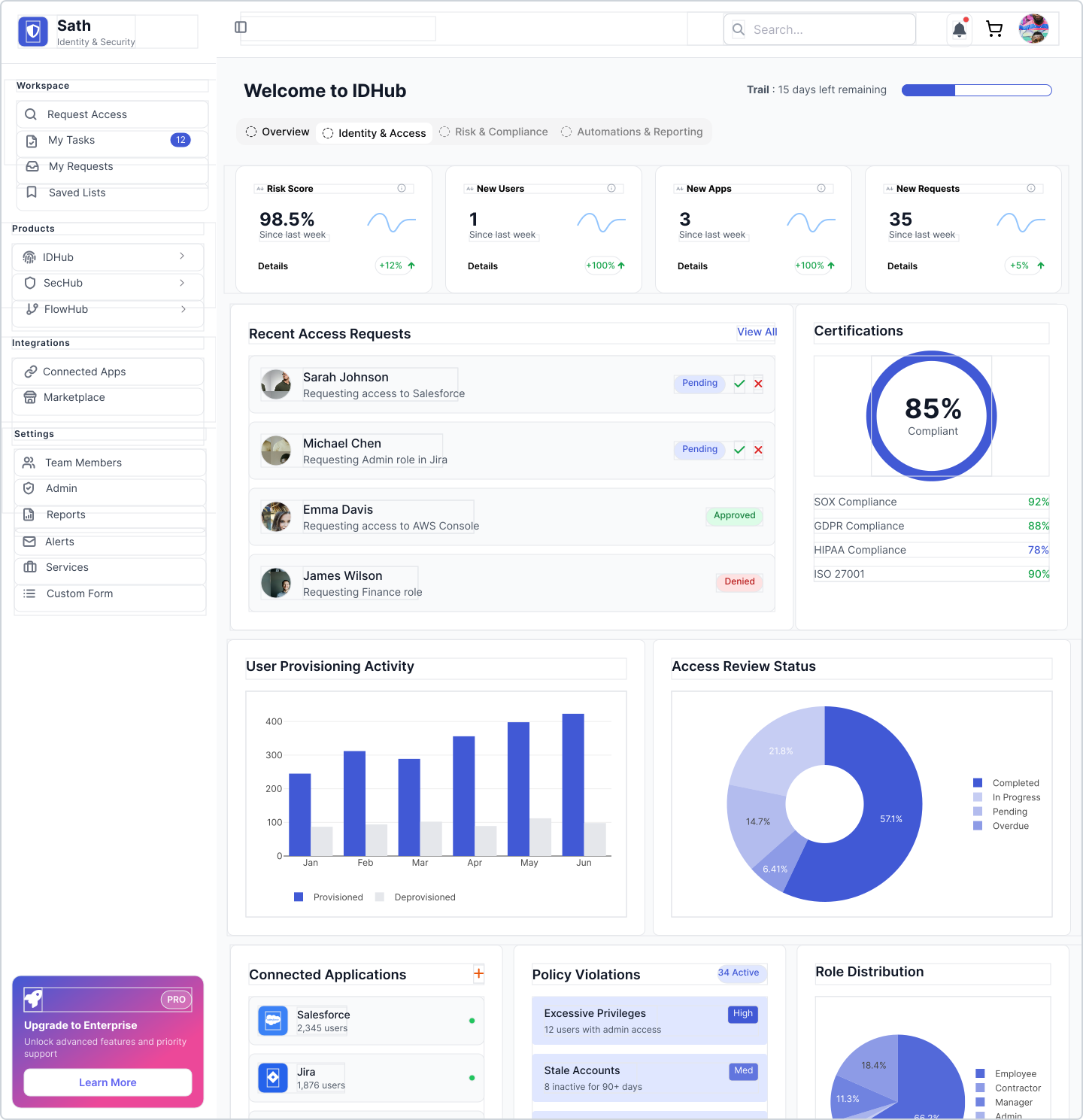
The Detection Architecture Gap: Why the Threat Is Outrunning the Stack
The threat landscape has structurally changed. The average enterprise today operates across hybrid cloud, distributed endpoints, SaaS applications, and containerized workloads each generating telemetry at volumes that have rendered manual triage operationally impossible. Adversary dwell time has compressed from weeks to hours, and credential-based attacks now constitute the dominant initial access vector in the majority of enterprise breaches. The perimeter, as an organizing security concept, is gone.
Legacy security architectures were not designed for this environment. A first-generation SIEM built to collect and store logs provides visibility, but not speed. A standalone EDR tool protects endpoints while ignoring identity-layer movements and cloud-workload pivots. Bolt-on integrations create correlation gaps, not coherence. The result is a fragmented alert landscape that overburdens SOC analysts, drives false-positive fatigue, and leaves attackers free to operate in the blind spots between tools.
The industry's response consolidating to XDR is correct in principle but frequently incomplete in execution. Most XDR platforms still rely on shallow data lakes, identity signals that arrive as an afterthought rather than a primary detection source, and detection logic that cannot distinguish low-and-slow reconnaissance from authorized administrative activity.
Sath's approach begins where others stall: at the intersection of behavioral analytics, cross-domain telemetry, and native identity governance. The Real Time Threat Detection engine the analytical core of the SIEM & XDR platform is engineered to process event streams across endpoints, networks, cloud workloads, and identity systems within a unified detection fabric.
By natively integrating IDHub's identity governance telemetry directly into the detection layer, the platform is designed to deliver the identity-layer context that pure-play XDR solutions structurally lack: who accessed what, when, from where, and whether that access was consistent with established behavioral patterns. The result is a detection posture engineered to reduce mean time to detect, eliminate alert silos, and give security leadership a single, authoritative threat picture.
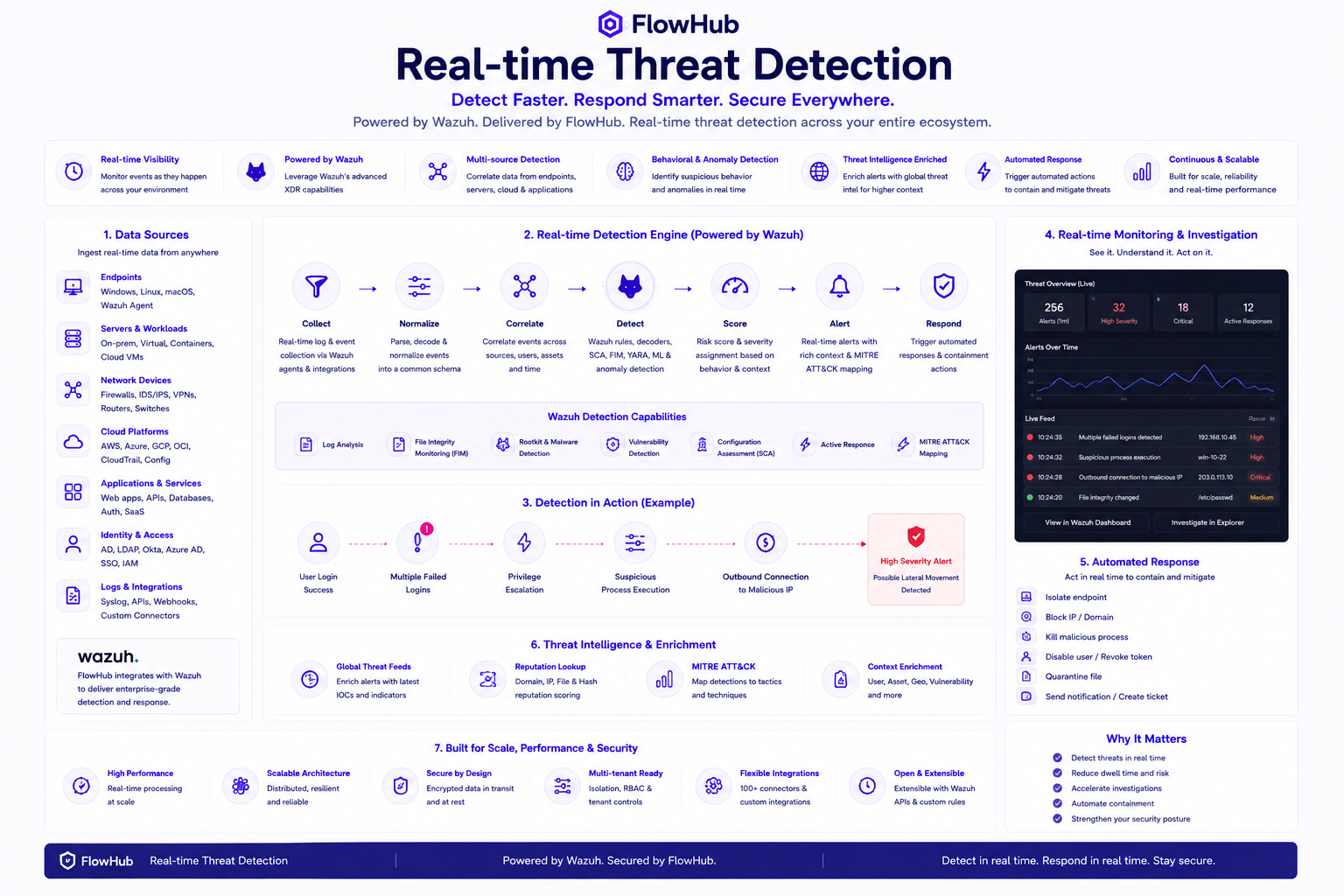
Why This Is an Engine, Not a Dashboard?
A note on platform architecture for evaluators and security architects.
Real Time Threat Detection is not a standalone product. It is the detection and analytics engine that powers Sath's SIEM & XDR platform. Think of it as the intelligence layer: the component responsible for ingesting raw telemetry, applying behavioral models, correlating multi-source signals, assigning dynamic risk scores, and producing the high-confidence incidents that SOC analysts act on.
The broader Sath SIEM & XDR platform governs the surrounding operational architecture: log storage and data management, case management and response workflows, SOAR orchestration, compliance reporting, and the operator console.
This distinction matters because detection quality determines everything downstream. Alert fidelity, MTTR, analyst productivity, and regulatory defensibility all trace back to whether the detection engine surfaced the right signal, in the right context, at the right time.
Real Time Threat Detection Engine Capabilities
Graph-Based Threat Correlation
The architecture intends to utilize advanced graph analytics to automatically map relationships between isolated security events.
Planned mapping of fragmented indicators directly to the MITRE ATT&CK tactical framework.
Engineered to visually connect adversarial lateral movement across disparate enterprise network segments.
Designed to analyze sequential event timelines to identify stealthy, multi-stage attack chains.
Intended to transition analysts away from investigating disconnected logs toward full incident narratives.
Built to automatically evaluate early-stage indicators of attack against known adversarial behaviors.
Aimed at instantly clarifying the potential blast radius of a compromised corporate asset.
Fusion-Driven Behavioral Analytics
The engine is being built to establish dynamic baselines using machine learning to detect subtle entity deviations.
Engineered to continuously assess daily operational patterns to uncover hidden insider threats.
Designed to recognize when authorized service accounts exhibit unusual data access frequencies.
Planned integration of statistical modeling to bypass the systemic limits of static signatures.
Intended to identify sophisticated evasion techniques commonly deployed by modern ransomware operators.
Built to adapt its sensitivity dynamically based on the observed context of the environment.
Structured to prioritize behavioral anomalies that carry a high probability of malicious intent.
Risk-Based Alert Prioritization
The detection layer plans to implement dynamic entity risk scoring to drastically reduce critical analyst alert fatigue.
Designed to automatically calculate risk scores based on user privilege and asset criticality.
Intended to elevate the visibility of security events targeting highly sensitive administrative accounts.
Planned capability to suppress redundant or benign operational anomalies automatically.
Engineered to filter out standard vulnerability scanning noise from the active security queue.
Built to ensure the operations center focuses exclusively on high-confidence, actionable incidents.
Aimed at providing a mathematically rigorous foundation for prioritizing incident response workflows.
Identity-Centric Zero Trust Validation [Planned]
By deeply integrating with IDHub, the system will embed verified identity context directly into every detection.
Planned capability to instantly cross-reference network anomalies against established access governance policies.
Designed to flag impossible travel logins immediately across distributed geographic access points.
Engineered to correlate unusual endpoint command executions with recent administrative privilege changes.
Intended to inject verifiable zero-trust intelligence into the initial alert triage phase.
Built to identify dormant account reactivations initiated by external, unauthorized threat actors.
Structured to highlight critical discrepancies between user behavior and their assigned corporate role.
Continuous Threat Intelligence Enrichment
The analytical core is planned to automatically augment internal telemetry with globally sourced adversary intelligence feeds.
Architected to cross-reference observed domain names against actively updated malicious infrastructure databases.
Designed to identify external IP addresses associated with known state-sponsored threat groups.
Intended to recognize file hashes matching the latest polymorphic malware campaign signatures.
Planned mechanism to enrich alert metadata with deep, actionable external security context.
Built to empower proactive threat hunters with current insights into emerging global tactics.
Engineered to ensure internal detection logic evolves constantly alongside shifting cyber threat landscapes.
Accelerated Triage And Investigation
The system is structured to provide security teams with a unified, context-rich environment for resolving complex incidents.
Planned delivery of centralized investigation workflows to support rapid tactical threat visualization.
Designed to package all necessary forensic data into a highly accessible, coherent format.
Engineered to support advanced, customized query languages for proactive organizational threat hunting.
Intended to allow seamless pivoting between the initial alerting mechanism and root cause analysis.
Built to consolidate disparate evidence points, preventing analysts from constantly switching console windows.
Structured to prepare verified, high-fidelity incident data for immediate handoff to automated remediation.
Architectural Execution: The Threat Neutralization Lifecycle
Continuous Baseline Monitoring
Rather than functioning as a passive data repository, the analytical engine continuously maps enterprise activity states, establishing highly accurate behavioral baselines for users and assets to identify subtle deviations indicative of early-stage reconnaissance.
Algorithmic Threat Evaluation
The core logic layer applies advanced Bayesian network modeling and behavioral heuristics to active environmental shifts, moving beyond signature matching to expose obfuscated lateral movement and complex exploitation attempts with mathematical precision.
Zero-Trust Contextualization
Identified anomalies are immediately cross-referenced against identity governance frameworks like Sath IDHub, injecting verifiable access privileges and dynamic entity risk scores directly into the incident profile to validate the true severity of the threat.
Automated Adversary Disruption
Upon confirming a high-fidelity threat narrative, the engine triggers bi-directional containment protocols, orchestrating instantaneous network isolation and identity revocation commands to neutralize the adversary long before analytical exhaustion paralyzes the operations center.
Executive Value Proposition
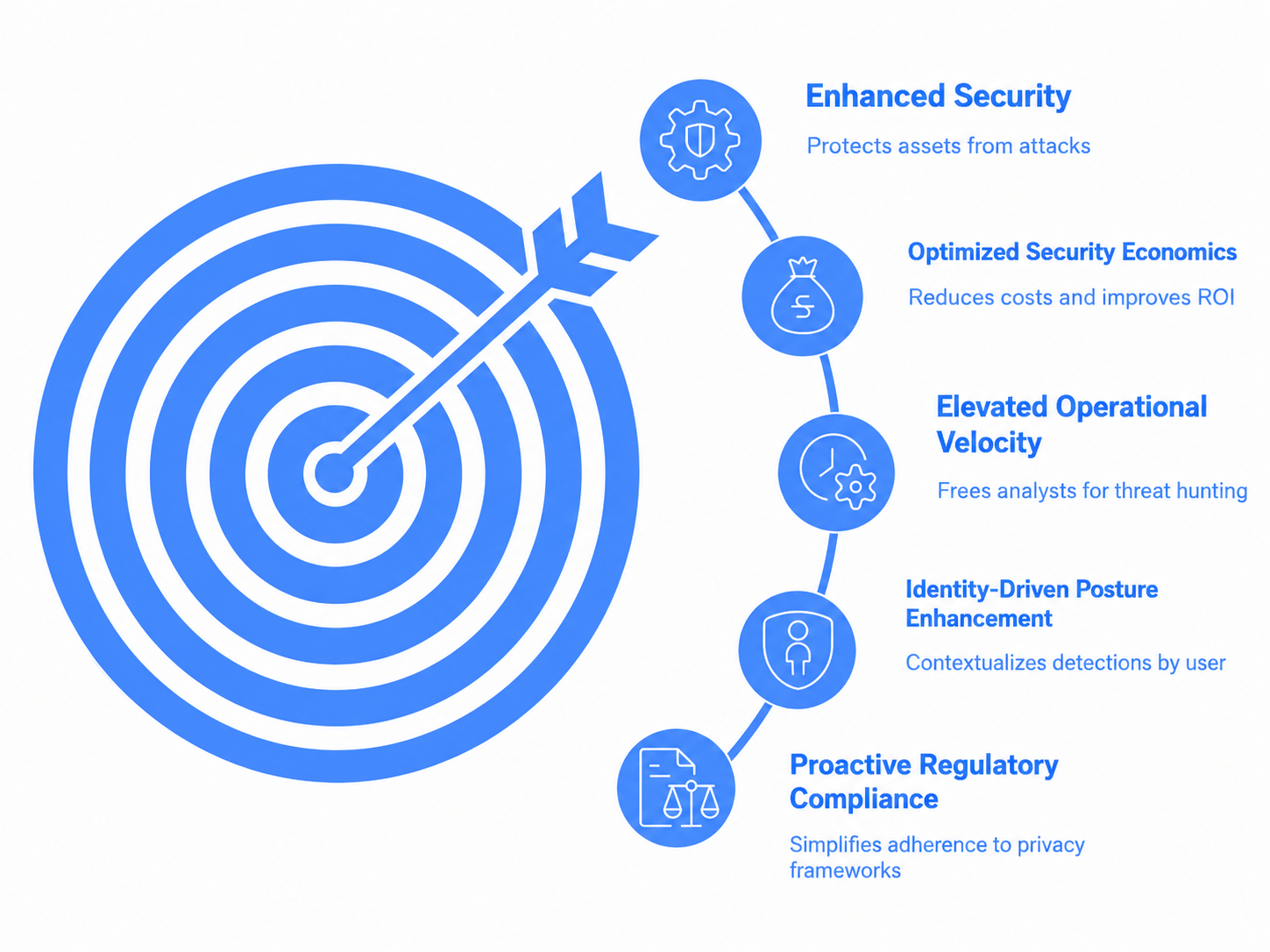
- Strategic Risk Mitigation: The detection layer is engineered to drastically reduce enterprise risk by identifying sophisticated attack vectors early in the kill chain, protecting critical assets from ransomware campaigns and unauthorized exfiltration before severe operational impact occurs.
- Optimized Security Economics: By unifying complex analytical capabilities within a single detection architecture, security leadership can anticipate streamlined operations, reduced maintenance overhead, and a highly efficient technology stack that delivers superior return on investment without punitive data ingestion penalties.
- Elevated Operational Velocity: The planned incorporation of intelligent, risk-based alert prioritization aims to minimize systemic alert fatigue, freeing elite security analysts from manual log triage so they can focus exclusively on high-value threat hunting and rapid adversary neutralization.
- Identity-Driven Posture Enhancement: Leveraging native integrations with identity governance platforms ensures that every detection is contextualized by user privilege, providing executive leadership with a verifiable, zero-trust approach to monitoring enterprise access, anomalous behavior, and internal risk.
- Proactive Regulatory Compliance: Designed to maintain continuous, automated oversight into critical access violations and administrative modifications, the detection engine intends to simplify adherence to stringent global privacy frameworks, actively safeguarding the organizational reputation against costly audit failures.
Regulatory Resilience by Architecture
Compliance should be a byproduct of good security architecture, not a separate audit program. The Sath SIEM & XDR platform's detection engine is designed so that the evidence it generates to detect threats is the same evidence that satisfies regulatory requirements—eliminating the traditional cost and friction of maintaining parallel compliance workflows.
Target framework alignment (planned):
- SOX (Sarbanes-Oxley): Automated access logging, segregation-of-duties monitoring, and audit trails for financial system access, via native IDHub integration.
- PCI-DSS v4.0: Continuous monitoring of cardholder data environment access, real-time alerting on unauthorized access attempts, and forensic log retention.
- GDPR / UK-GDPR: Data access anomaly detection, breach detection workflows, and audit log exportability to support 72-hour notification obligations.
- ISO/IEC 27001:2022: Detection controls aligned to Annex A threat monitoring, incident management, and access control requirements.
- SOC 2 Type II: Continuous control monitoring across availability, confidentiality, and security Trust Services Criteria.
- FFIEC / GLBA: Identity access monitoring and incident detection capabilities aligned to financial services regulatory expectations.
The Identity Telemetry Advantage: IDHub as a Native Detection Source
Why identity signals change the detection equation—and why most platforms treat them as an afterthought.
The most consequential evolution in enterprise attack patterns over the last five years is the systematic targeting of identity infrastructure. Adversaries compromise credentials, abuse legitimate access, and move laterally under the cover of authorized user activity—specifically because most detection systems are built to monitor network behavior, not access behavior.
IDHub is Sath's identity governance and access management platform. Its core capabilities—role-based access control, automated provisioning and deprovisioning, access certification, and privileged access management—generate a continuous stream of identity lifecycle events that carry deep detection value.
When IDHub's telemetry feeds natively into the Real Time Threat Detection engine, the combined platform gains capabilities that siloed architectures cannot replicate:
- Access-to-behavior correlation: A user whose access was provisioned three minutes ago and who immediately queries a sensitive database is a different risk signal than a tenured employee accessing the same data in a routine workflow. The detection engine is designed to understand this distinction.
- Privilege escalation chain detection: Lateral movement frequently involves incremental privilege accumulation. IDHub's governance telemetry is engineered to make each step in that chain visible to the detection layer.
- Zero-trust policy enforcement at the detection layer: Zero-trust architectures require continuous verification of access appropriateness. The IDHub integration is designed to surface access that is technically authorized but contextually anomalous—a distinction that pure-play XDR platforms structurally cannot make.
- Regulatory alignment by design: For organizations under SOX, GLBA, PCI-DSS, or FFIEC obligations, the convergence of access governance and detection telemetry into a single platform creates a compliance posture that is architecturally coherent, rather than assembled from disconnected tools.
Target Use Cases
The Real Time Threat Detection engine, operating within the Sath SIEM & XDR platform, is architected to address the following high-priority security operations scenarios:
Insider Threat Detection Behavioral anomaly detection and IDHub access telemetry combine to surface data exfiltration attempts, unauthorized access to sensitive systems, and policy violations by internal actors including privileged users and third-party contractors.
Credential Compromise & Identity-Based Attack Detection The integration of IAM lifecycle events with network and endpoint telemetry is designed to identify compromised credential use, impossible travel scenarios, MFA bypass attempts, and privilege escalation chains across hybrid environments.
Ransomware & APT Early Warning Streaming behavioral analytics and threat intelligence fusion are engineered to identify the reconnaissance, lateral movement, and staging behaviors that precede ransomware deployment and advanced persistent threat campaigns—earlier in the kill chain than signature-based detection allows.
Cloud Workload & SaaS Visibility The platform is architected to extend detection coverage into cloud-native and SaaS environments, addressing the visibility gap that endpoint-centric tools cannot fill in distributed, cloud-first architectures.
SOC Analyst Efficiency & Alert Fatigue Reduction Risk-based prioritization, incident consolidation, and automated triage enrichment are designed to allow SOC analysts to focus investigation effort on threats that warrant human judgment—rather than spending productive capacity on noise management.
Regulatory Audit Readiness The continuous generation of forensic-grade, framework-aligned evidence trails is designed to make audit readiness a persistent operational state, rather than a quarterly preparation exercise.