Endpoint Threat Visibility
Most enterprise breaches begin on an endpoint—not because endpoints are uniquely vulnerable, but because most organizations cannot see deeply enough into what executes on them. Sath's Endpoint Threat Visibility layer, the telemetry collection and investigation surface within the SIEM & XDR platform, is engineered to deliver forensic-depth process, memory, and behavioral data from every managed endpoint providing the observational depth that evasion-focused adversaries are explicitly designed to prevent.
The Observation Deficit: What Endpoint Protection Has Consistently Failed to Provide
The endpoint remains the most consequential point of failure in enterprise security architecture. It is where initial access is established, credentials are harvested, memory is manipulated, and legitimate administrative tools are turned against the organizations that installed them. Despite decades of endpoint protection investment, the fundamental problem has not changed: most organizations do not know—with the precision that investigation and pre-breach hunting demand what is actually executing on their managed devices at any given moment.
Signature-based antivirus and first-generation EPP tools were designed for a threat model that no longer reflects adversary behavior. Today's most consequential endpoint attacks are explicitly engineered to evade them. Living-off-the-Land techniques weaponize PowerShell, WMI, Remote Desktop, and other built-in system binaries that antivirus engines are configured to trust. Fileless malware executes entirely in memory, writing nothing to disk and leaving no artifact for file-scanning tools to find. Process injection hijacks legitimate processes to carry out malicious operations under trusted parent processes. These techniques dominate the attack landscape precisely because they render signature-based detection operationally blind.
The visibility problem is compounded by asset inventory reality. The average enterprise manages endpoints across corporate offices, remote worker environments, contractor devices, and unmanaged nodes each category representing a potential telemetry gap. An endpoint that cannot be seen is, by definition, not protected. Coverage gaps in endpoint telemetry directly correlate with longer attacker dwell times and failed containment outcomes.
Sath's Endpoint Threat Visibility layer the telemetry collection, asset discovery, and endpoint investigation surface within the SIEM & XDR platform is engineered to address the visibility deficit: providing security teams granular, high-fidelity endpoint telemetry, continuous device inventory, and a forensic investigation workspace that allows them to reconstruct with precision exactly what occurred on any managed endpoint during any threat event.
What the Endpoint Threat Visibility Layer Does and Does Not Do?
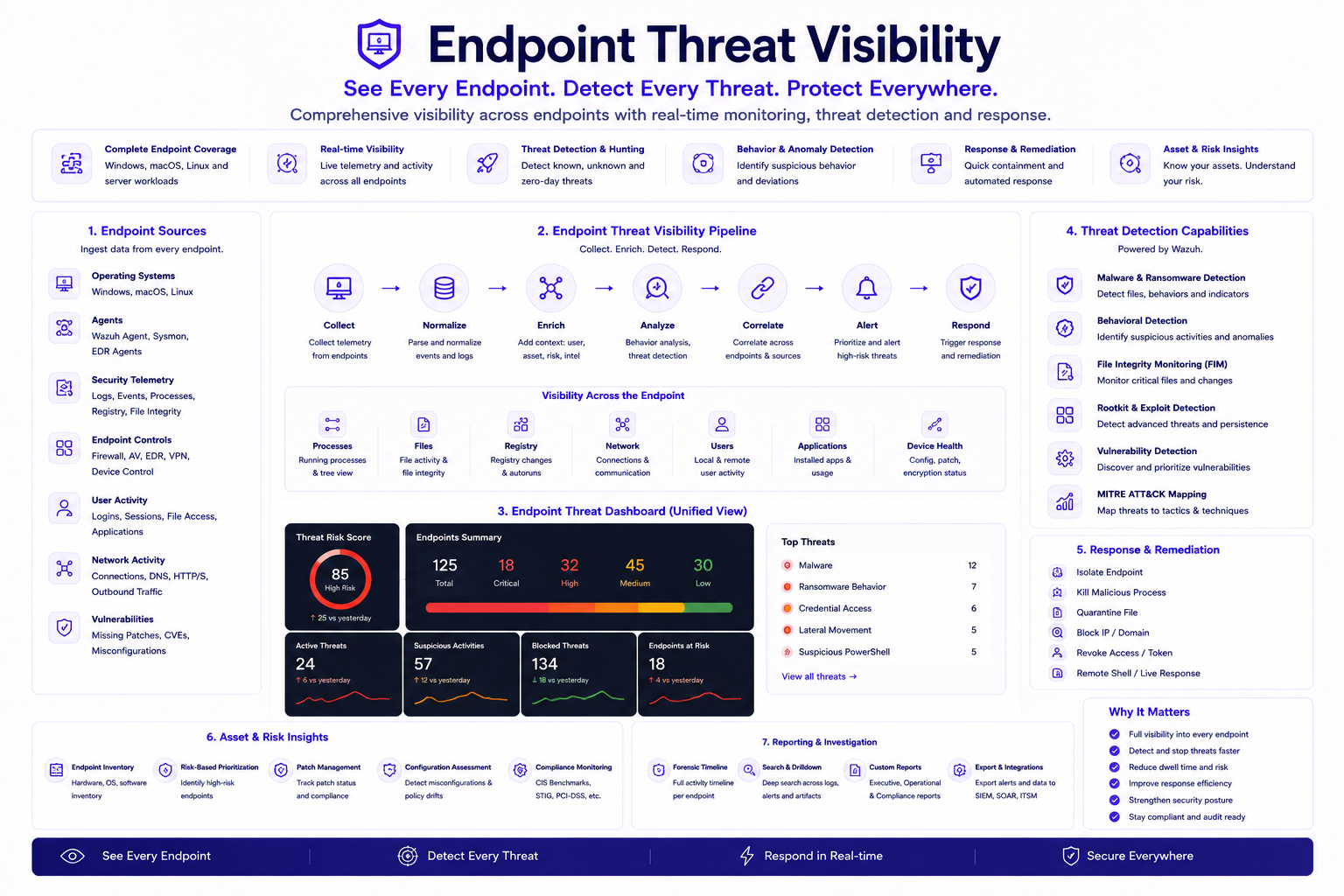
Endpoint Threat Visibility is the observation foundation: the layer responsible for collecting, normalizing, and preserving the granular telemetry that every downstream platform function depends on. The platform's detection engine analyzes the telemetry this layer provides to generate high-confidence threat signals; the response engine acts on those confirmed signals. Detection quality is bounded by telemetry quality—if the observation layer is incomplete, every downstream function operates on a degraded foundation regardless of its analytical sophistication. Endpoint Threat Visibility is the layer that determines the ceiling of everything else.
The Real Time Threat Detection and Automated Incident Response layers are documented separately.
Endpoint Threat Visibility Capabilities
Deep Endpoint Telemetry Collection
The visibility layer collects a comprehensive, normalized stream of low-level endpoint activity data covering process execution, file system operations, network connections, registry modifications, and kernel-level behavioral events providing the granular observational record from which all platform intelligence functions operate.
Process execution tree capture including full command-line arguments, parent-child process relationships, and spawning context for every process event
File system event recording covering file creation, modification, deletion, and access operations across configured paths and sensitivity tiers
Registry read, write, and deletion event logging for keys and values commonly abused in persistence, privilege escalation, and LotL attack techniques
Network connection telemetry binding process identity to outbound and inbound connection records, enabling process-level attribution for network-based threat scenarios
Kernel-level event collection for behavioral data that userland telemetry cannot capture, including driver loads, token manipulation events, and memory allocation anomalies [Planned]
Normalized telemetry output structured to feed the platform's detection engine without transformation overhead, maintaining event fidelity from collection through downstream analysis
Continuous Endpoint Asset Discovery & Coverage Intelligence
Security posture is only as strong as its weakest unmonitored device; the visibility layer is designed to continuously enumerate the managed device estate, surface previously unknown endpoints, and maintain a live telemetry health record that exposes coverage gaps before attackers exploit them.
Continuous network-based device enumeration to discover managed, unmanaged, and previously unknown endpoints across enterprise network segments
Real-time agent health monitoring tracking telemetry connectivity, version currency, and collection completeness for every enrolled device
Coverage gap reporting surfacing devices with degraded telemetry, outdated agents, or intermittent connectivity that create observational blind spots in the endpoint estate
Device classification and asset inventory enrichment mapping discovered endpoints to asset categories, business unit ownership, operating system, and criticality tier
Shadow IT and rogue device alerting for endpoints that appear on monitored network segments without corresponding managed-device records
Automated onboarding workflow support enabling security teams to move newly discovered devices from discovery status to full telemetry enrollment without manual agent deployment overhead [Planned]
Fileless Malware & Living-off-the-Land Behavioral Visibility
The visibility layer is architected to observe the specific process execution patterns, binary abuse sequences, and in-memory behavioral signatures that characterize the most prevalent advanced endpoint attack techniques providing the observational depth that file-scanning and signature-based tools structurally cannot deliver.
Anomalous execution chain detection for built-in Windows administrative binaries including PowerShell, WMI, MSHTA, Rundll32, and Remote Desktop when executed in atypical parent-child process contexts
Script execution content capture for PowerShell, VBScript, and JavaScript interpreters, recording decoded and deobfuscated execution content regardless of obfuscation technique applied [Planned]
Process memory event visibility for detecting code injection, reflective DLL loading, and in-memory payload execution that leaves no disk-resident artifacts for file-based tools to scan
Macro and document-embedded execution monitoring for identifying Office application process trees that spawn unexpected child processes consistent with malicious macro execution
LOLBin (Living-off-the-Land Binary) activity profiling that distinguishes malicious abuse of trusted system binaries from legitimate administrative usage through execution context analysis
Persistence mechanism visibility covering scheduled task creation, registry run-key modification, service installation, and startup folder manipulation used by attackers to survive endpoint reboots
Forensic Endpoint Investigation Workspace
Beyond telemetry collection, the visibility layer provides security analysts and threat hunters with a structured investigation environment, a queryable, time-bounded, visualized workspace for reconstructing endpoint event sequences, tracing attack paths, and answering the forensic questions that incident investigation and proactive hunting require.
Visual process tree timeline reconstruction presenting endpoint events as an annotated, chronological execution graph from any selected time window in the telemetry record
Historical telemetry query capability enabling analysts to search backward through retained endpoint event records using structured queries without requiring active incident context [Planned]
Attack path tracing that links initial execution events through persistence establishment, privilege escalation, and lateral movement preparation into a single navigable investigation narrative
Pivot capability allowing analysts to move from a suspicious process event to related file, network, or registry events associated with the same process without leaving the investigation console
Evidence preservation and annotation tools enabling analysts to mark, tag, and export endpoint event records for legal hold, regulatory submission, or post-incident review documentation [Planned]
MITRE ATT&CK technique tagging embedded within the investigation workspace as a forensic navigation aid—labeling observed endpoint behaviors so analysts can structure investigation hypotheses and move between the event record and the adversary playbook without leaving the timeline
Endpoint Posture & Vulnerability Exposure Assessment
The visibility layer extends beyond active threat observation to provide continuous assessment of endpoint security posture, surfacing unpatched vulnerabilities, security configuration drift, and policy compliance deviations that represent exploitable conditions before adversaries identify and act on them.
Continuous vulnerability exposure inventory mapping discovered software versions and system configurations against known CVE databases to surface unpatched exposure by endpoint and severity tier [Planned]
Security baseline deviation detection identifying endpoints whose configuration has drifted from approved security policy—disabled security controls, weakened authentication settings, and unauthorized software installations
Operating system and application patch currency tracking across the managed device estate with gap reporting organized by criticality, asset tier, and time since patch availability
Local administrator privilege mapping identifying endpoints where accounts hold excessive local permissions inconsistent with organizational policy or the principle of least privilege [Planned]
Endpoint security control health monitoring ensuring that protective controls—including host-based firewall rules, disk encryption status, and agent integrity—are operational and correctly configured on every enrolled device
Risk-scored posture dashboard aggregating per-endpoint exposure data into an estate-level posture view that security leadership can use to prioritize remediation investment and demonstrate posture improvement over time [Planned]
Identity Binding via IDHub
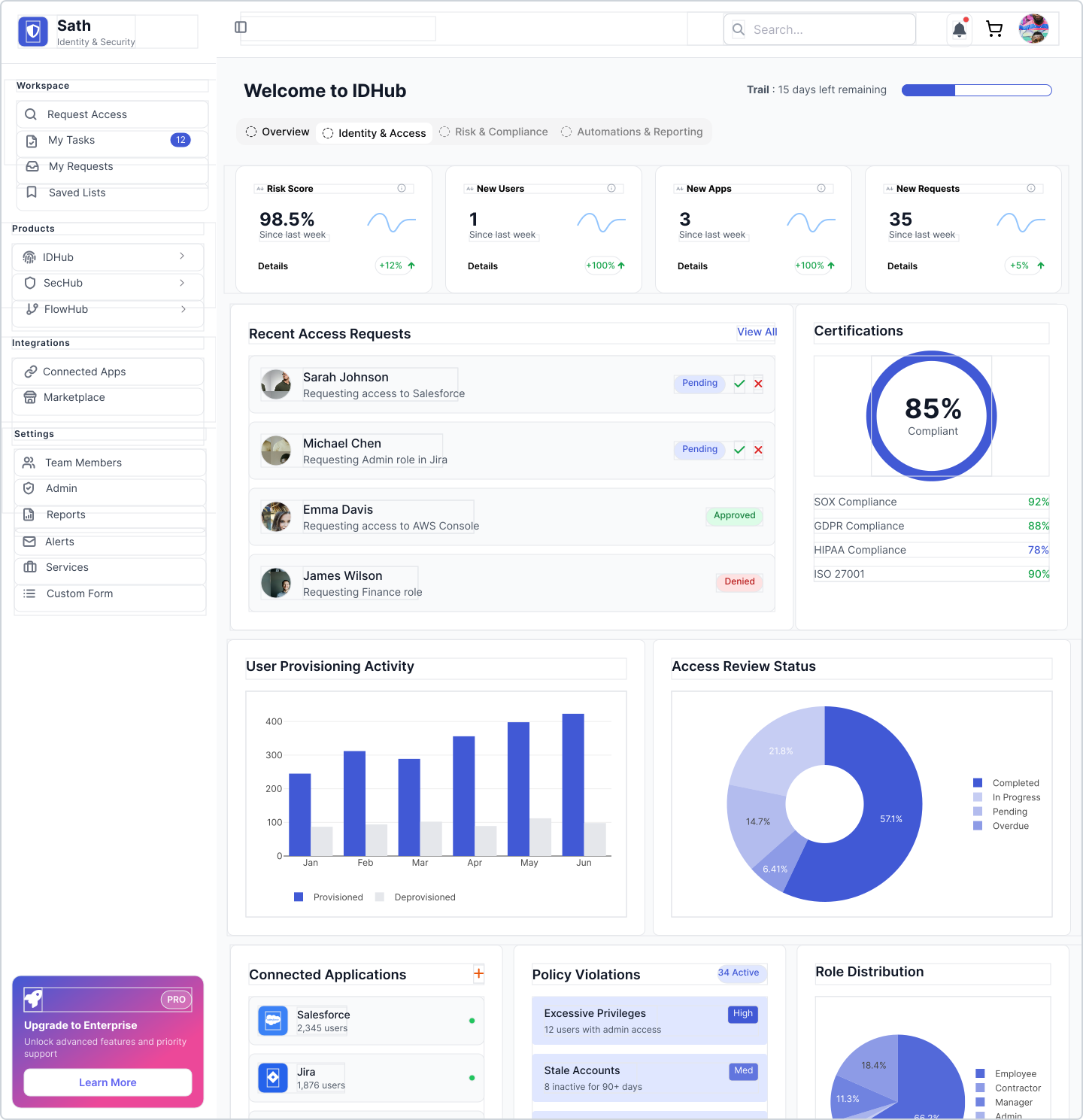
By integrating natively with IDHub's identity governance records, the visibility layer enriches every endpoint telemetry event with the authenticated user's full identity and access governance context, transforming raw process and file events into identity-attributed activity records that support forensic investigation, access-behavior analysis, and regulatory evidence obligations.
Real-time binding of endpoint session and process activity records to the authenticated user's IDHub identity profile, entitlement record, and organizational role data
Access entitlement context surfaced alongside endpoint events, so investigators can immediately determine whether the user executing a suspicious process held legitimate authorization for the systems and data they accessed
Forensic identity state reconstruction assembling the user's exact IDHub governance record at the precise time of the suspicious endpoint event—entitlements held, certification status, and whether access to the systems involved was in organizational scope at that moment—without requiring manual pivot to a separate IAM console
Privileged session attribution mapping administrative-tool executions to the specific privileged account active at the time, enabling forensic accountability for all actions taken under elevated permissions
Forensic identity timeline reconstruction combining endpoint activity records with IDHub access logs into a unified per-user investigation view spanning both the endpoint and the identity governance record [Planned]
Regulatory identity-attribution evidence packaging assembling the user identity, endpoint activity, and access entitlement records required to demonstrate who accessed what, from where, and with what authorization—in the structured format that SOX, PCI-DSS, and GDPR audit obligations require [Planned]
The Three Questions Every Security Team Needs Answered
Endpoint Threat Visibility is architecturally designed around three operational mandates that define what genuine endpoint observability requires.
I. Can I see every endpoint in my estate?
Asset coverage is the precondition for all endpoint security outcomes. The Endpoint Threat Visibility layer is designed to continuously discover managed and previously unknown devices, maintain a real-time device inventory with health and telemetry-coverage status, and surface coverage gaps before they become exploitation paths.
II. Can I see what is actually executing—including in memory and under trusted processes?
Fileless attacks, process injection, and LotL techniques are invisible to tools that observe only the file system. The visibility layer is architected to collect process execution trees, parent-child process relationships, in-memory behavioral events, and the specific abuse patterns of trusted administrative binaries—providing the observational depth that adversaries depend on security tools lacking.
III. When something happens, can I reconstruct it precisely?
Post-incident investigation and pre-breach threat hunting both require a continuous, high-fidelity record of endpoint activity that can be queried backward in time. The investigation workspace within the visibility layer is designed to allow analysts to reconstruct exact execution sequences, trace attack paths, and answer forensic questions with the granularity that legal, compliance, and incident response obligations demand.
Executive Security Value
Breach Cost Containment
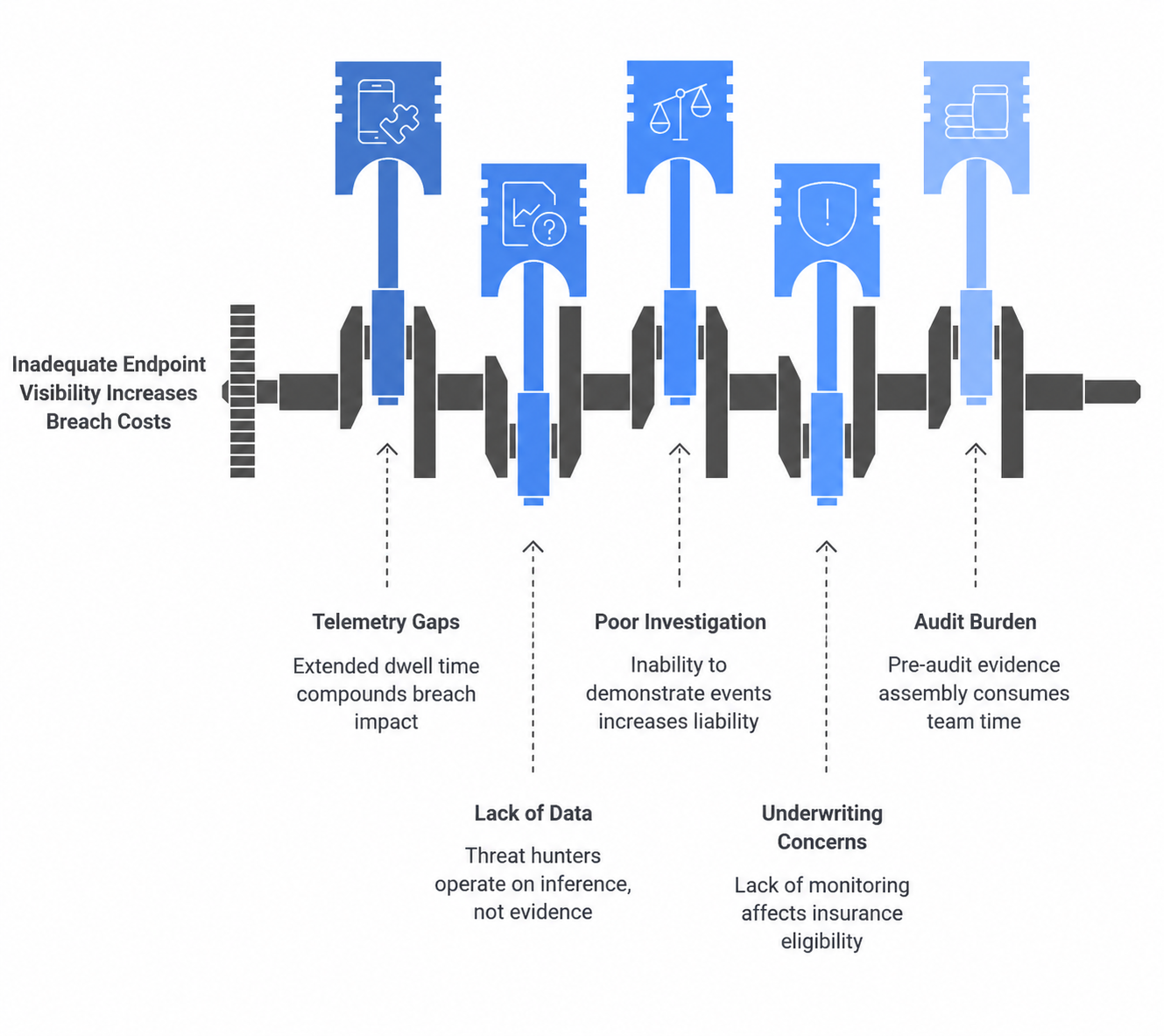
Attacker dwell time is the primary cost multiplier in enterprise breaches: longer dwell compounds remediation scope, regulatory exposure, and reputational damage. Telemetry coverage gaps are the principal driver of extended dwell. Complete endpoint visibility directly limits the window during which an attacker operates unobserved—before the detection layer has anything to act on.
Threat Hunt Program Economics
Without a high-fidelity, historically queryable endpoint telemetry record, threat hunters operate on inference rather than evidence. Hypothesis-driven hunting—the kind that surfaces adversaries who have not yet triggered alerts—requires the data substrate this layer provides. Without it, a threat hunt program is an aspiration; with it, it is a structured, repeatable operation.
Litigation and Regulatory Liability
Forensic investigation quality determines whether an organization can demonstrate—with evidentiary precision—what happened on a specific system during a specific window, and equally, what did not happen. That demonstrability defines liability posture in regulatory breach notification proceedings and civil litigation alike. The investigation workspace is designed to produce that evidence as a continuous byproduct of monitoring, not reconstruct it under pressure after the fact.
Cyber Insurance Underwriting Position
Underwriters increasingly assess continuous monitoring coverage—specifically, whether all endpoints are enrolled and telemetry is demonstrably active—as a material factor in policy terms and coverage eligibility. The ETV layer's continuous asset inventory and telemetry health records produce the documented evidence that underwriting assessments require.
Audit Evidence Cost Elimination
Pre-audit evidence assembly for endpoint access monitoring obligations—collecting logs, validating coverage, documenting device enrollment consumes substantial security and compliance team time annually. Continuous monitoring that generates structured coverage evidence as a byproduct of normal operations eliminates that burden as a discrete, recurring workload.
The Monitoring Coverage Question: Regulatory Evidence the Other Layers Cannot Produce
Why continuous endpoint observability is a distinct regulatory obligation—and why it must be answered before detection and response evidence becomes relevant.
Regulatory frameworks for enterprise security impose three distinct evidence obligations, each owned by a different layer of the security architecture:
The detection layer answers: What threats were identified, and when? Detection evidence demonstrates that the security stack was analytically capable of recognizing an attack.
The response layer answers: What was done about it, and how quickly? Response evidence demonstrates that the organization acted appropriately once an incident was confirmed.
The Endpoint Threat Visibility layer answers: Were you watching—continuously, across all in-scope systems—before anything happened?
This third question is the one most organizations cannot answer with evidence. Regulatory auditors increasingly require proof not just that an incident was detected and handled, but that monitoring coverage was active and demonstrably complete across all regulated systems throughout the audit period. A detection alert proves the monitoring system fired when it fired. A continuous asset inventory and telemetry health record proves the system was watching before it fired—and that no in-scope endpoint operated outside the monitoring perimeter. That proof is what this layer is uniquely positioned to produce.
Target framework alignment for continuous monitoring coverage evidence (planned):
- PCI-DSS v4.0 (Requirements 10, 11): Requirement 10 mandates audit log generation from all in-scope system components throughout the review period. The ETV layer's continuous device enrollment records, telemetry health status, and coverage gap reports directly evidence that all cardholder data environment systems were under active, uninterrupted monitoring—the precondition that makes detection and forensic evidence credible to a QSA.
- SOX (Sarbanes-Oxley — IT General Controls): External auditors assessing IT General Controls require evidence that monitoring was operational across financial systems for the full audit period, not just at the point of an event. The ETV layer's continuous agent health records and device inventory documentation support the operational continuity assertion that SOX IT audits require.
- GDPR / UK-GDPR (Article 32): Article 32 requires "appropriate technical measures" to ensure ongoing confidentiality, integrity, availability, and resilience of processing systems. Continuous telemetry coverage and documented asset inventory are the operational evidence that technical safeguards were actively in place—not just configured but continuously verified as operational—across all systems processing personal data.
- ISO/IEC 27001:2022 (Annex A.5.9, A.8.8): ISO 27001 Annex A explicitly requires a documented, maintained inventory of information assets and associated monitoring controls. The ETV layer's continuous asset discovery and telemetry health records provide the living evidence artifact that supports these Annex A control requirements at certification and surveillance audit.
- HIPAA (Security Rule — § 164.312(b) Audit Controls): The HIPAA Security Rule requires covered entities to implement hardware, software, and procedural mechanisms that record and examine activity in systems containing ePHI. Continuous telemetry coverage across all ePHI systems, verified through agent health monitoring, is the technical demonstration that audit controls were operational rather than merely configured. [Planned]
- FFIEC / NIST CSF (Identify Function): The NIST CSF Identify function—which financial regulators reference directly—requires a continuously maintained asset inventory and identification of all systems in the organizational operating environment. The ETV layer's continuous device discovery and classification addresses this function as an operational, continuously updated output rather than a periodic spreadsheet exercise.
The IDHub Identity Attribution Advantage: Knowing Who, Not Just What
Why binding identity governance records to endpoint telemetry is architecturally distinct from both detection and response—and why it matters for investigation quality.
Endpoint telemetry, in isolation, tells you what happened: which process executed, which file was accessed, which network connection was established. It does not, on its own, tell you who was accountable for it—not at the level of organizational identity with a full governance record, access entitlement history, and audit accountability.
When a suspicious process executes on an endpoint, the investigation question is not just "what process was this"—it is "who was authenticated on this device, what access entitlements do they hold, and is this activity consistent with their organizational role and access baseline?" Without IDHub integration, answering those questions requires pivoting to a separate IAM system, manually cross-referencing access records, and assembling a picture that should be immediate and automatic.
Sath IDHub's governance record is not simply a user directory—it is an access intelligence layer. It holds the complete entitlement record for every user: what they are authorized to access, when that authorization was granted or modified, whether it has been certified, and whether any access review has surfaced concerns. When the Endpoint Threat Visibility layer binds that record to endpoint telemetry events, every process execution and file access event in the investigation workspace carries full identity governance context—without manual lookup.
The investigative advantages are precise:
- Immediate accountability determination: Forensic investigators see not just the process and the device, but the user identity, their access profile, and whether their presence on that system at that time was consistent with their governance record.
- Privileged access forensic tracing: Administrative tool executions are attributed not to generic service accounts, but to specific governed identities—creating a complete audit record of every privileged action taken during the threat event window.
- Forensic governance state reconstruction: When investigating a confirmed endpoint event, IDHub's point-in-time governance records allow analysts to reconstruct exactly what access the user held at the time of the event, what had recently changed in their entitlement profile, and whether any pending access review had flagged concerns—without the manual cross-referencing that normally consumes investigation time.
- Regulatory attribution evidence: SOX, PCI-DSS, GDPR, and FFIEC all impose requirements to demonstrate who accessed sensitive systems and data during relevant time windows. The combination of endpoint telemetry and IDHub entitlement records produces this evidence without requiring post-incident manual assembly.
Target Use Cases
The Endpoint Threat Visibility layer is engineered to address the following high-priority scenarios where the quality and completeness of endpoint observation directly determines security outcome.
Fileless & LotL Attack Identification When adversaries weaponize trusted system binaries and execute payloads entirely in memory, only deep process-level and memory-event telemetry reveals their presence. The visibility layer is designed to deliver the observational depth that signature-based tools structurally never reach—by collecting process-level, memory-event, and binary-execution telemetry that file-scanning tools cannot capture, because these attacks leave no file-based artifact to scan.
Proactive Threat Hunting Threat hunters require a high-fidelity, historically queryable endpoint telemetry record to search for adversary indicators that have not yet generated alerts. The forensic investigation workspace is designed to provide the data substrate and query capability that structured, hypothesis-driven threat hunting demands.
Incident Root-Cause Investigation When the response layer confirms and closes an incident, the investigation question becomes: precisely what happened, when, and how? The visibility layer's event record and investigation workspace are designed to reconstruct the complete execution sequence—from initial foothold through lateral movement—with the forensic precision that post-incident analysis, legal holds, and regulatory inquiries require.
Unmanaged & Shadow IT Device Risk Management Every unmanaged device on an enterprise network that lacks endpoint telemetry enrollment is a potential blind spot. The continuous asset discovery capability is designed to surface those devices, quantify the coverage gap they represent, and support a structured workflow for bringing them under managed telemetry.
Endpoint Security Posture Benchmarking Security leadership requires a continuous, accurate picture of endpoint security posture across the device estate—patch gaps, configuration deviations, and control health—to make informed investment decisions and demonstrate security program maturity to boards, auditors, and insurers. The posture assessment capability is designed to provide that picture without requiring a separate vulnerability management tool.
Regulatory Access Audit Evidence Collection For organizations under SOX, PCI-DSS, GDPR, or FFIEC obligations, the combination of endpoint telemetry and IDHub identity attribution creates a continuously generated, structured evidence record of who accessed what, on which system, and with what entitlement authorization—designed to eliminate the manual evidence assembly that dominates pre-audit preparation cycles.